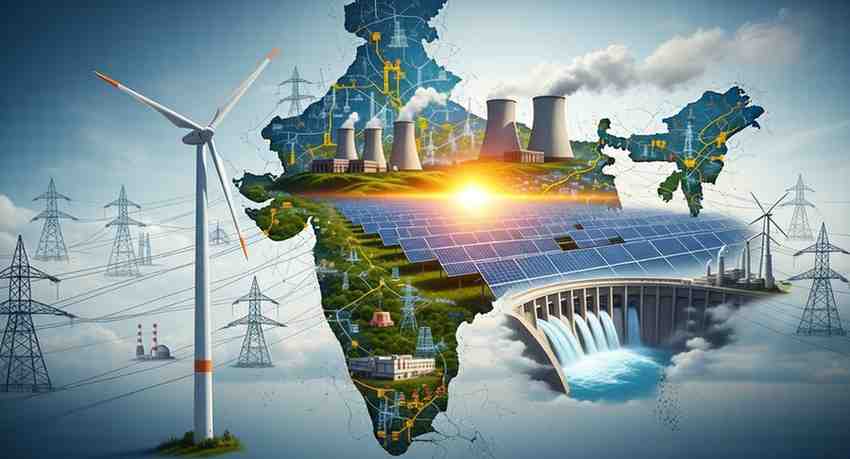
India's Installed Power Capacity Surpasses 520 GW, Renewables Lead the Way
India's total installed power capacity has crossed the 520 gigawatt (GW) milestone, with more than half now generated from non-fossil fuel sources , Union Minister of State for Power and New and Renewable Energy Shripad Yesso Naik announced while addressing the India Energy Transition Summit 2026 in New Delhi. The summit was organized by the Federation of Indian Chambers of Commerce and Industry (FICCI) .
The Minister emphasized that India's energy transition is actively underway , supported by sustained policy clarity and significant investments in renewable infrastructure, reflecting the country's commitment to a sustainable energy future.
Rapid Growth in Renewable Energy Capacity
India's solar capacity has more than tripled in recent years , demonstrating the mainstreaming of renewable energy within the national power mix. Government initiatives, including competitive bidding frameworks and the expansion of Green Energy Corridors , have significantly accelerated deployment across the country. The development of ultra-mega renewable energy parks and widespread rooftop solar installations under the PM Surya Ghar Yojana have further strengthened distributed generation and encouraged active consumer participation in the clean energy transition.
Commitment to 2030 and 2070 Climate Goals
India has set an ambitious target of achieving 500 GW of non-fossil fuel capacity by 2030 , aligning with its long-term climate strategy to reach net zero emissions by 2070 . Officials at the summit underscored that this shift to clean energy not only fulfills global climate commitments but also critically addresses domestic energy security needs, reducing dependence on volatile fossil fuel imports.
Economic and Strategic Benefits of Transition
Beyond significant emission reductions, the ongoing energy transformation is expected to deliver substantial economic dividends. These include enhanced industrial competitiveness, large-scale employment generation, and reduced reliance on imported fuels . Expanding renewable capacity also contributes to greater grid resilience, energy independence, and long-term economic stability , positioning India as a global leader in sustainable development.
Exam-Focused Important Facts:
-
Installed Capacity: India's total power capacity has surpassed 520 GW .
-
Renewable Share: More than 50% is now from non-fossil fuel sources (solar, wind, hydro, nuclear).
-
2030 Target: Achieve 500 GW of non-fossil fuel capacity.
-
2070 Pledge: Achieve net zero emissions .
-
Key Initiatives: Green Energy Corridors (for transmission) and PM Surya Ghar Yojana (rooftop solar).
Month: Current Affairs - March 01, 2026
Category: Energy Transition | Renewable Energy