New Amphibian Species Found in Peru’s High-Altitude Forests
Researchers have documented a previously unknown frog species in the montane cloud forests of northern Peru, drawing attention to both the region’s exceptional biodiversity and the mounting threats faced by fragile mountain ecosystems. The species, named Oreobates shankusacha , was identified by a collaborative team of Peruvian and French scientists with assistance from local indigenous communities.
Field Discovery in San Martín’s Cloud Forest Belt
The amphibian was encountered in the San Martín region within dense, moisture-rich cloud forest habitat. The finding has been formally described in the peer-reviewed journal Salamandra . Field surveys located the frog on the forest floor, where it occupies microhabitats formed by leaf litter, moss mats and fern cover—typical niches for ground-dwelling Andean amphibians that depend on stable humidity.
Morphology and Cultural Significance of the Name
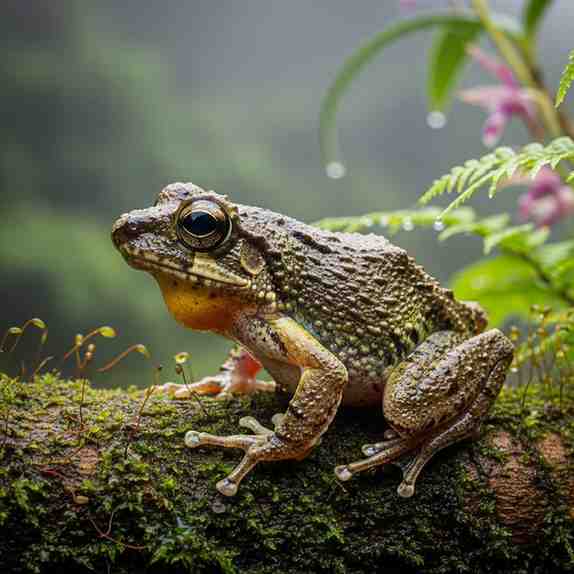
Oreobates shankusacha is a small terrestrial frog measuring roughly 2.5 centimetres (about one inch) in length. It displays a dark brown body and conspicuous golden eyes, traits that provide camouflage among decomposing vegetation. The species name honours indigenous heritage: in the Kichwa-Lamista language, “shanku sacha” translates to “heart of the forest,” acknowledging the ecological stewardship of local communities.
Restricted Range and Specialised Ecology
The frog inhabits cloud forests situated above approximately 1,350 metres (4,430 feet). These environments are naturally fragmented along mountain ridges, creating isolated ecological pockets that often harbour endemic fauna. Observations indicate nocturnal activity patterns, with individuals emerging at night to forage for small invertebrates across the forest substrate.
Immediate Conservation Concerns
Scientists caution that the species may already face a high extinction risk due to rapid land-use change. Significant portions of the surrounding forest landscape have been cleared for coffee plantations, grazing and illegal timber extraction. Given its narrow distribution and dependence on intact, humid forest cover, researchers have recommended consideration for endangered status to prioritise habitat protection.
Exam-Focused Points
-
Cloud forests occur at high elevations and support high endemism.
-
Amphibians are sensitive bioindicators of environmental change.
-
Newly described species often receive names reflecting local culture or geography.
-
Deforestation for agriculture remains a primary driver of biodiversity loss in the Amazon basin.
Month: Current Affairs - Feb 10, 2026
Category: Environment & Biodiversity