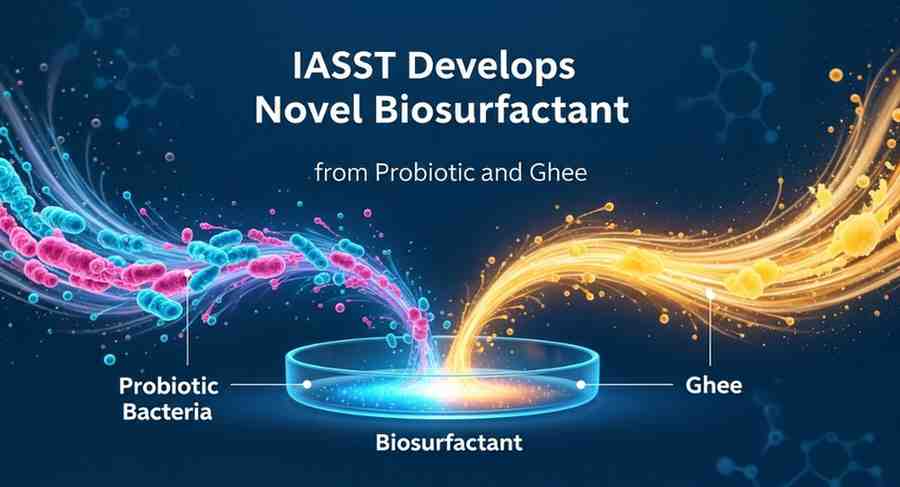
DST Institute Synthesises Eco-Friendly Alternative to Synthetic Surfactants
An institute functioning under India’s Department of Science and Technology (DST) has developed a new biosurfactant derived from natural ingredients, offering a sustainable substitute for synthetic surfactants used in cosmetics and pharmaceuticals. The innovation was achieved at the Institute of Advanced Study in Science and Technology (IASST) in North East India by a research team led by Director Prof. Ashis K. Mukherjee, along with Prof. M. R. Khan and senior research fellow Anushree Roy.
Probiotic-Based Innovation
The biosurfactant was synthesised using Lactobacillus plantarum JBC5, a probiotic bacterium, with ghee serving as the lipid-rich substrate. Researchers applied response surface methodology to optimise production parameters and enhance yield efficiency. The resulting compound is classified as a lipopeptide biosurfactant, combining lipid and peptide components.
This approach integrates traditional food-based substrates with modern biotechnological processes, highlighting sustainable production pathways.
Antibacterial and Functional Performance
Laboratory evaluations revealed significant antibacterial activity against Staphylococcus aureus , a pathogen frequently linked to skin and wound infections. When incorporated into commercial facial cleansers, the biosurfactant improved stain-removal performance.
The compound achieved an emulsification index of up to 60% with edible oils and effectively reduced surface tension. It also demonstrated stability across diverse pH ranges and temperatures up to 276°C, indicating strong industrial applicability.
Environmental Relevance
Conventional surfactants, though widely used as emulsifiers and dispersants, often pose environmental and health concerns due to limited biodegradability. Bio-based surfactants derived from microbial processes present a safer and eco-friendly alternative.
Important Facts for Exams
-
DST operates under the Ministry of Science and Technology.
-
Biosurfactants are surface-active agents produced by microorganisms.
-
Staphylococcus aureus causes skin and wound infections.
-
Lipopeptides contain both lipid and peptide structures.
Further toxicity testing and industry collaborations are underway to facilitate large-scale production. If commercialised successfully, the biosurfactant could reduce dependence on synthetic chemical surfactants in consumer and medical products.
Month: Current Affairs - March 01, 2026
Category: Science & Technology | Biotechnology