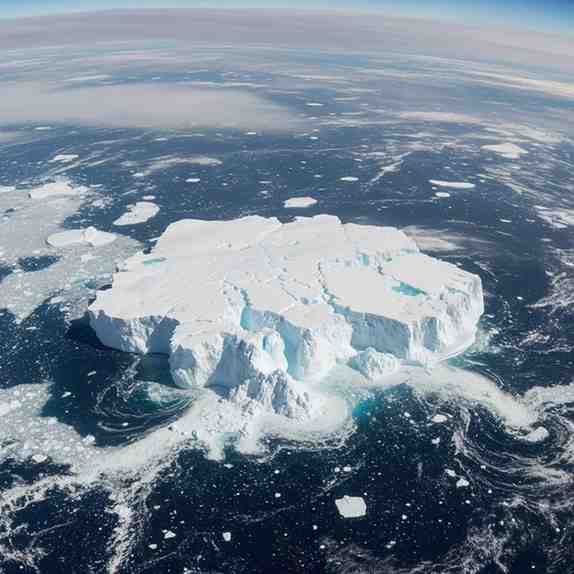
Iceberg A23a Enters Final Phase of Disintegration, Satellite Data Shows
Satellite observations have confirmed that iceberg A23a , once the largest iceberg in the world by surface area , is now in the final stage of disintegration. Data captured by China’s advanced meteorological satellite system indicate that the massive Antarctic ice body is shrinking rapidly and could vanish entirely in the coming weeks.
Fengyun-3D Satellite Detects Sharp Decline
According to the China Meteorological Administration , true-colour images recorded on January 14 by the Fengyun-3D show that A23a’s remaining core has reduced to approximately 506 square kilometres .
This represents a steep decline from:
-
~4,170 sq km at the time of calving in 1986
-
~948 sq km just three weeks earlier
The pace of reduction highlights how quickly large ice masses can destabilise once structural weakening reaches a critical threshold.
Role of the Fengyun-3 Satellite Constellation
The Fengyun-3D satellite is part of China’s Fengyun-3 polar-orbiting satellite constellation , which has been tracking A23a continuously since 2023. With a spatial resolution of 250 metres , the system enables scientists to monitor fine-scale changes in ice structure, meltwater formation, and fragmentation patterns across polar regions.
Researchers noted that the iceberg’s breakup rate accelerated markedly in early 2026, coinciding with peak austral summer conditions.
Why Iceberg A23a Is Breaking Apart
Scientists attribute the rapid disintegration primarily to hydrofracturing —a process in which surface meltwater penetrates deep crevasses and fractures within the ice. Satellite imagery has revealed:
-
Blue meltwater ponds forming on the iceberg’s surface
-
Water trapped within the central basin due to raised ice ridges along the margins
As meltwater exerts downward pressure, internal cracks widen, causing large sections to split off. Seasonal factors have intensified this process, including higher air temperatures , clearer skies , and warmer surrounding seawater exceeding 3°C in parts of the Southern Ocean.
Long Journey from Antarctic Shelf to Fragmentation
Iceberg A23a originally broke away from Antarctica’s Filchner Ice Shelf in 1986 and drifted across the Southern Ocean for nearly four decades. According to Zheng Zhaojun of China’s National Satellite Meteorological Center, the iceberg has now reached a stage where complete disintegration is imminent .
Smaller fragments are being carried northward by ocean currents into warmer waters, accelerating melting and structural collapse.
Exam-Focused Points
-
A23a calved from the Filchner Ice Shelf in 1986 .
-
It was once the largest iceberg in the world by surface area .
-
Month: Current Affairs - January 21, 2026
Category: Environment & Ecology | Climate Change