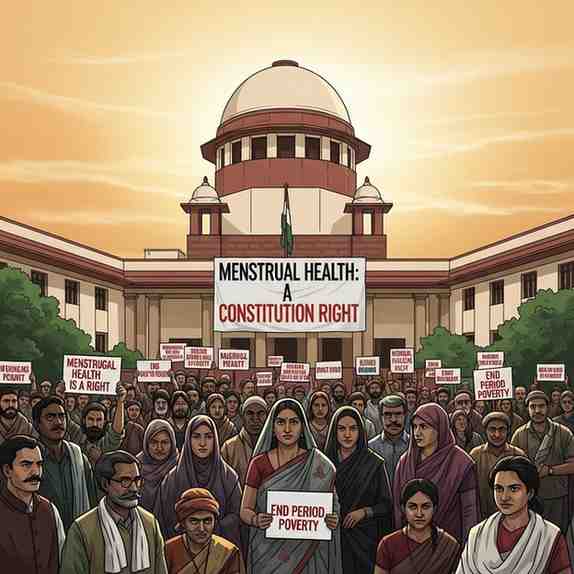
Landmark Verdict Links Menstrual Dignity to Article 21
In a significant constitutional development, the Supreme Court has ruled that menstrual health is integral to the right to dignity, thereby deserving constitutional protection. The judgement reframes menstrual hygiene from a welfare concern to a fundamental rights issue, directly addressing the structural dimensions of “period poverty” in India.
Menstrual Health as a Dignity Issue
The Court emphasised that dignity under Article 21 extends beyond survival to encompass conditions necessary for a life of self-respect. It observed that improvements in sanitation infrastructure — including toilet construction and tap-water access — have not automatically translated into effective menstrual hygiene management. Many facilities remain inaccessible or non-functional, exposing persistent gaps between policy formulation and implementation.
Implementation Deficits Highlighted
The ruling flagged governance failures, noting that several states and Union Territories did not respond to prior judicial directions concerning menstrual hygiene policies. The Court interpreted this silence as evidence of inadequate administrative prioritisation. It clarified that although menstruation affects only a section of the population, constitutional guarantees of dignity and equality apply uniformly.
Public Health and Social Consequences
The judgement acknowledged the multidimensional impact of menstrual deprivation on health, education, mobility and livelihoods. Conditions such as premenstrual syndrome (PMS), premenstrual dysphoric disorder (PMDD) and endometriosis remain underdiagnosed, often due to stigma and lack of awareness. The Court underscored the need for a systemic health approach integrating awareness, early diagnosis and accessible care.
Education and Environmental Dimensions
Gender-inclusive menstrual education was identified as essential to dismantle stigma. The Court indirectly reinforced the importance of informed choice, including awareness of disposable and reusable menstrual products. Sustainable alternatives — such as menstrual cups and cloth pads — were noted for their economic and environmental advantages when supported by adequate infrastructure.
Important Facts for Exams
-
Article 21 guarantees the right to life and dignity.
-
Menstrual hygiene management links to SDGs on health, sanitation and gender equality.
-
Rashtriya Kishor Swasthya Karyakram (RKSK) addresses adolescent health.
-
Bureau of Indian Standards sets quality norms for consumer goods.
Civil Society and Accountability
Recognising the contribution of non-governmental initiatives, the Court stressed that durable progress requires institutionalised collaboration, monitoring frameworks and accountability mechanisms.
Month: Current Affairs - February 18, 2026
Category: Polity & Constitution | Social Justice