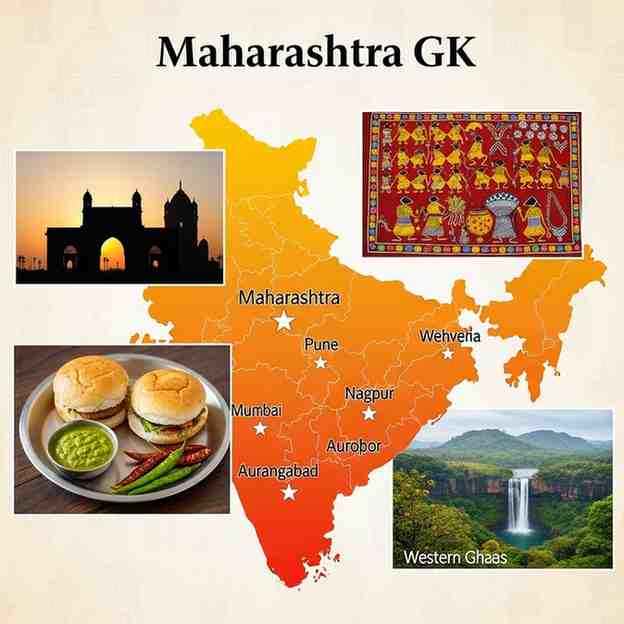
1. Basic Identity
-
Formation Date: May 1, 1960 (as part of the Bombay Reorganisation Act)
-
Capital: Mumbai (Financial Capital of India)
-
Second Capital: Nagpur (Winter Session of the State Legislature is held here)
-
Official Language: Marathi
-
State Animal: Indian Giant Squirrel (Shekru)
-
State Bird: Yellow-footed Green Pigeon (Hariyal)
-
State Tree: Mango Tree (Aamra)
-
State Flower: Jarul (Tamhan)
2. Geography
-
Location: Western and Central India
-
Coastline: Konkan Coast along the Arabian Sea (~720 km)
-
Major Regions:
-
Konkan: Coastal strip with Mumbai, Thane, Raigad, Ratnagiri, Sindhudurg.
-
Western Ghats (Sahyadri): Mountain range, a UNESCO World Heritage Site for its biodiversity.
-
Desh / Khandesh: Plateau region including Pune, Ahmednagar, Nashik.
-
Marathwada: Aurangabad, Beed, Latur, Nanded, etc.
-
Vidarbha: Nagpur, Amravati, Akola, Chandrapur, etc.
-
Major Rivers: Godavari, Krishna, Bhima, Tapi, Wardha, Painganga.
-
Major Dams:
-
Koyna Dam (Satara) - Hydroelectricity
-
Jayakwadi Dam (Paithan) - On Godavari
-
Bhatsa Dam (Thane) - Water for Mumbai
-
Totladoh Dam (Nagpur) - Irrigation in Vidarbha
3. History at a Glance
-
Ancient: Ruled by Mauryas, Satavahanas (who established Pratishthana - modern Paithan), Vakatakas, Chalukyas, Rashtrakutas.
-
Medieval: The Yadavas of Devagiri were the last major Hindu kingdom before the Delhi Sultanate.
-
Maratha Empire (1645-1818):
-
Founder: Chhatrapati Shivaji Maharaj (coronated in 1674 at Raigad Fort).
-
Peshwa Era: The prime ministers of the Maratha Empire, with their capital in Pune, expanded the empire across India.
-
Colonial Era:
-
Post-Independence: The state of Bombay was split on a linguistic basis on May 1, 1960 , creating the Marathi-speaking state of Maharashtra and the Gujarati-speaking state of Gujarat.
4. Government and Politics
-
Chief Minister: Eknath Shinde
-
Deputy Chief Ministers: Devendra Fadnavis & Ajit Pawar
-
Governor: Ramesh Bais
-
Administrative Divisions: 6 Revenue Divisions (Konkan, Pune, Nashik, Aurangabad, Amravati, Nagpur)
-
Number of Districts: 36
-
Lok Sabha Seats: 48
-
Vidhan Sabha Seats: 288
5. Economy & Industry
Maharashtra is the most industrialized and economically developed state in India.
-
GDP: Contributes the largest share to India's GDP.
-
Industries:
-
Automobile: Pune (Detroit of India), Nashik, Aurangabad.
-
IT & ITES: Mumbai, Pune, Nagpur.
-
Finance: Mumbai is home to the RBI, Bombay Stock Exchange (BSE), and National Stock Exchange (NSE).
-
Entertainment: Mumbai is the hub of the Hindi film industry (Bollywood) and Marathi cinema.
-
Textiles: Mumbai, Ichalkaranji, Malegaon.
-
Jewellery: Mumbai is a major center for diamond polishing and jewellery making.
-
Agriculture: Major producer of sugarcane, cotton, soybean, tur (pigeon pea), and oranges (Nagpur).
-
Minerals: Coal (in Vidarbha), Bauxite, Iron ore.
6. Culture & Heritage
-
Festivals:
-
Ganesh Chaturthi: The most popular festival, publicly celebrated with great enthusiasm since the time of Lokmanya Tilak.
-
Gudi Padwa: Marathi New Year.
-
Makar Sankranti (Pedda Panduga): Celebrated as Til Gul .
-
Pola: Festival honoring bullocks.
-
Cuisine:
-
Popular Dishes: Vada Pav, Misal Pav, Puran Poli, Sabudana Khichdi, Poha, Bharli Vangi, Pithla-Bhakri.
-
Seafood: Dominant in the Konkan region.
-
Sweets: Modak, Shrikhand, Basundi, Puran Poli.
-
Music & Dance:
Month: Current Affairs - Nov 30, 2025
Category: