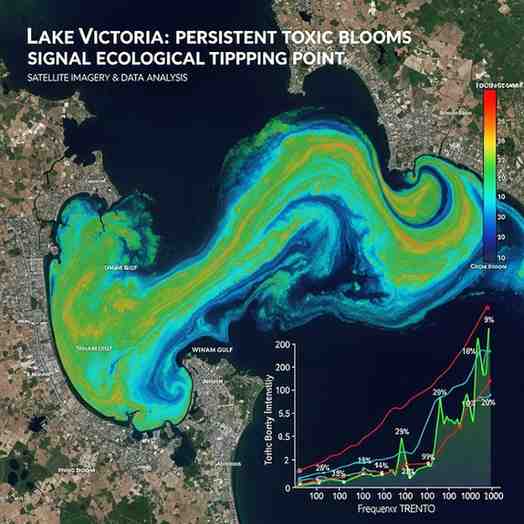
Nutrient Pollution Drives Eutrophication Crisis in Lake Victoria
The waters of Lake Victoria, the world’s largest tropical lake, have undergone a visible transformation, with toxic green algal blooms shifting from seasonal events to a near-permanent condition. The lake sustains roughly 47 million people across Kenya, Tanzania, and Uganda, serving as a critical source of drinking water, fisheries, and transport. Scientists caution that prolonged nutrient enrichment has pushed the ecosystem toward a dangerous threshold.
Nutrient Overload and Eutrophication
Harmful algal blooms stem from eutrophication, triggered by excessive nitrogen and phosphorus inputs. In Lake Victoria’s densely inhabited basin, nutrient loading arises from fertiliser runoff, untreated sewage, industrial effluents, soil erosion, and atmospheric deposition. Heavy rainfall during wet seasons accelerates nutrient transport into the lake.
Hydrological assessments highlight severe contamination levels. During peak rains, rivers such as the Nzoia contribute substantial nitrate inflows, with manure and sewage emerging as dominant nutrient sources. Expanding urbanisation and inadequate waste infrastructure intensify ecological stress.
Long-Term Ecological Shifts
Sediment core studies from Mwanza Gulf trace eutrophication trends back to the 1920s, coinciding with agricultural expansion and land-use change. Primary productivity rose steadily throughout the 20th century. By the 1990s, cyanobacteria had emerged as the dominant phytoplankton group.
Earlier ecological disruptions foreshadowed present challenges. Declines in zooplankton biomass around 1960 destabilised trophic dynamics, preceding widespread losses of native cichlid species in later decades. Fluctuating lake levels and altered hydrology further compounded habitat degradation.
Toxic Blooms and Health Risks
Cyanobacteria, particularly Microcystis, now produce microcystin — a potent liver toxin frequently detected above World Health Organization safety limits. Blooms may not always manifest as visible surface scums, allowing toxins to persist undetected. Genomic analyses reveal diverse cyanobacterial communities, underscoring evolving toxicological risks.
Important Facts for Exams
-
Lake Victoria is the world’s largest tropical lake by surface area.
-
Eutrophication results from excess nitrogen and phosphorus inputs.
-
Microcystin is a cyanobacterial toxin affecting liver health.
-
Lake Victoria is shared by Kenya, Tanzania, and Uganda.
Dead Zones and Fishery Pressure
Oxygen depletion has intensified, generating hypoxic “dead zones” that threaten aquatic biodiversity. With fisheries exceeding 300,000 tonnes annually, dominated by Nile perch, Nile tilapia, and dagaa, ecological instability poses serious socio-economic risks. Expanding low-oxygen zones narrow the margin between episodic fish mortality and systemic ecosystem collapse.
Month: Current Affairs - February 19, 2026
Category: Environment | Ecology