India Accelerates Final Push to Eliminate Legacy Waste Under "Lakshya: Zero Dumpsites" Mission
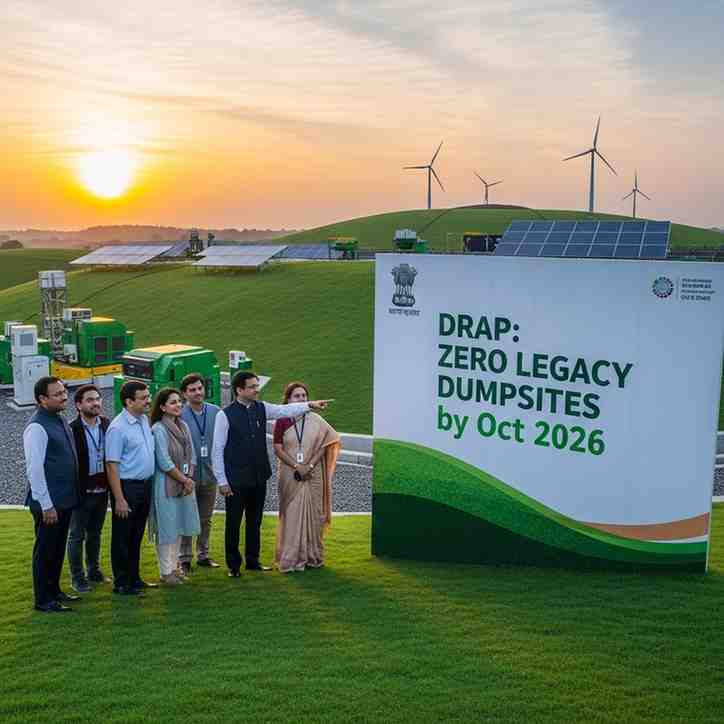
Building on a decade of progress under the Swachh Bharat Mission, India has launched an aggressive, time-bound national program to eliminate its most persistent urban cleanliness challenge: legacy waste dumpsites. The Dumpsite Remediation Accelerator Programme (DRAP) , launched in November 2025, targets achieving "Lakshya: Zero Dumpsites" by October 2026 , marking a decisive phase in the country's waste management journey.
The Scale of the Legacy Waste Crisis
Legacy dumpsites—landfills where municipal solid waste was unscientifically dumped over decades—represent a severe environmental and public health threat. They contaminate soil and groundwater, degrade air quality through toxic emissions and fires, and are significant sources of methane, a potent greenhouse gas. India faces a massive challenge, with approximately 2,479 identified legacy dumpsites holding nearly 25 crore metric tonnes (250 million tonnes) of waste spread across 15,000 acres of urban land.
The DRAP Strategy: A Targeted Acceleration
While remediation work is already underway at 1,428 sites, DRAP introduces a targeted, accelerated approach. It identifies 214 high-impact dumpsites across 30 States and Union Territories that alone account for nearly 80% of the remaining legacy waste burden (about 8.6 crore metric tonnes) . The program operates on a dual pillar: the scientific remediation of these historical waste mountains and the prevention of new ones by ensuring 100% scientific processing of fresh waste.
The 5P Framework and Biomining Technology
DRAP is anchored in the 5P framework of Swachh Bharat Mission-Urban 2.0 : Political Leadership, Public Finance, Partnerships, People’s Participation, and Project Management. The core technological solution is biomining , a process where legacy waste is excavated, stabilized, and mechanically segregated. Recovered materials are channeled into productive use:
-
Soil-like material used for landscaping or landfill cover.
-
Construction and Demolition (C&D) waste used in road projects.
-
Recyclables (plastic, metal, glass) sent to recycling industries.
-
High-calorific value waste directed to waste-to-energy plants.
Only the non-reusable, inert rejects are sent to new, scientifically engineered landfills.
From Wasteland to Green Wealth
The land reclaimed through this remediation is a valuable asset. It is earmarked for developing new solid waste management infrastructure —such as material recovery facilities and composting plants—or for creating green spaces , thereby transforming urban blights into community assets. This mission is critical for sustainable urban growth, significantly reducing emissions from the waste sector and aligning Indian cities with global environmental and climate goals.
Exam-Focused Important Facts:
-
Program: Dumpsite Remediation Accelerator Programme (DRAP).
-
Launch & Target: Launched in November 2025 ; targets "Zero Dumpsites" by October 2026 .
-
Scale: ~2,479 legacy dumpsites with ~25 crore metric tonnes of waste.
-
Focus: 214
Month: Current Affairs - February 03, 2026
Category: Environment | Urban Governance