| Category |
Key Facts |
| Formation |
March 30, 1949 |
| Capital |
Jaipur |
| Area |
Largest state in India (342,239 km²) |
| Geographical Features |
Aravalli Range, Thar Desert |
| State Animal |
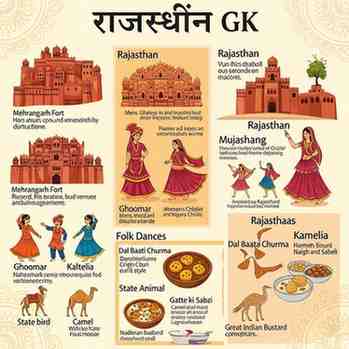
Camel & Chinkara |
| State Bird |
Godawan (Great Indian Bustard) |
| State Tree |
Khejri |
| State Flower |
Rohida |
Geography and Wildlife
- Rajasthan is in northwestern India and shares an international border with Pakistan. The Aravalli Range , one of the world's oldest mountain ranges, divides the state diagonally. To the west lies the Thar Desert (Great Indian Desert), while the east has more fertile plains.
The state is known for its national parks and tiger reserves:
-
Ranthambore National Park (Sawai Madhopur) and Sariska Tiger Reserve (Alwar) are famous for Bengal tigers.
-
Keoladeo National Park (Bharatpur) is a UNESCO World Heritage Site and a major bird sanctuary.
-
Desert National Park (Jaisalmer/Barmer) showcases the Thar Desert ecosystem and is a habitat for the Great Indian Bustard.
History and Culture
-
Ancient & Medieval History : Rajasthan was home to the Indus Valley Civilization (sites at Kalibangan and Balathal). It was later ruled by various Rajput dynasties like the Gurjar-Pratiharas , Chauhans , and the kingdom of Mewar , who resisted foreign invasions for centuries.
-
Formation of the State : The state was formed in seven stages between 1948 and 1956 through the integration of numerous princely states. The final and most significant step, "Greater Rajasthan" , was completed on March 30, 1949 , which is now celebrated as Rajasthan Foundation Day.
-
Cultural Heritage : Rajasthan has a vibrant culture with famous folk music and dances like Ghoomar and Kalbeliya . It is renowned for its majestic forts and palaces , intricate art and crafts, and colorful festivals like the Pushkar Fair .
Government and Administration
-
Administrative Structure : Rajasthan has a unicameral legislature (Legislative Assembly). The state is divided into 41 districts .
-
Panchayati Raj : The state has a three-tier system of rural local self-government: Zila Parishad (District level), Panchayat Samiti (Block level), and Gram Panchayat (Village level).
-
Key Officials : The Governor is the constitutional head of the state, while the Chief Minister is the head of the government.
Tips for Studying Rajasthan GK
-
Focus on Key Areas : For competitive exams, concentrate on history (integration of Rajasthan, ancient civilizations, freedom struggle), geography (rivers, climate, soil), and culture (folk music/dance, deities, fairs).
-
Use Maps : Study the location of districts, major cities, national parks, rivers, and the Aravalli Range to better understand geographical questions.
-
Practice with MCQs : Regularly solving multiple-choice questions from previous years' exam papers can be very helpful.
I hope this overview of Rajasthan GK is helpful for your preparation. If you are studying for a specific exam, feel free to ask, and I can provide more targeted information.
Month: Current Affairs - Oct 27, 2025
Category: