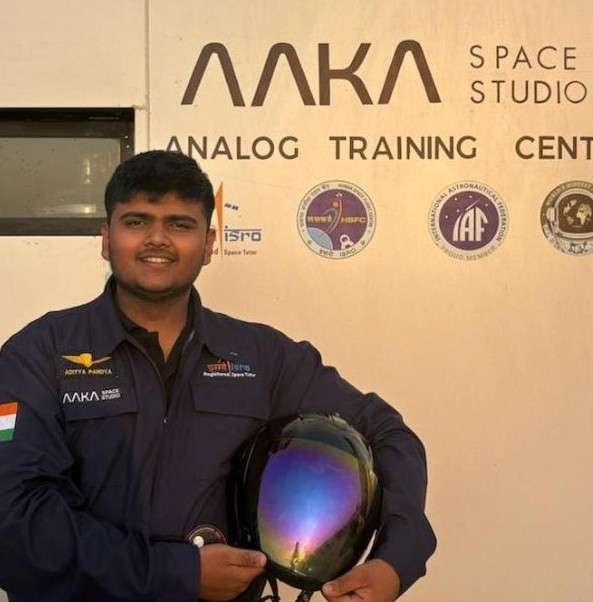
Teen Technologist Completes Lunar Analog Mission in Kutch
Seventeen-year-old Aditya Pandya has earned distinction as India’s youngest male analog astronaut after completing a Moon-habitat simulation organised by AAKA Space Studio. The mission was conducted from February 1 to 8 in the salt-white terrain of Dholavira in Gujarat’s Kutch district, an environment chosen for its resemblance to extraterrestrial landscapes. The initiative represents a significant advancement in India’s growing analog space research framework.
Simulating Lunar Isolation on Earth
The week-long exercise was structured to replicate the constraints expected in future lunar settlements, including isolation, restricted communication, confined living, and autonomous decision-making. A four-member crew resided within a specially designed container-based habitat, operating under simulated mission protocols.
The programme assessed long-duration confinement challenges, crew coordination, environmental sustainability systems, and mission-control integration. Such analog missions provide critical data for understanding human performance in off-Earth conditions without leaving the planet.
Dual Role: Crew Member and Systems Engineer
Aditya Pandya played a distinctive dual role during the mission. Apart from serving as a crew member, he functioned as the lead engineer overseeing hardware systems, Internet of Things (IoT) integration, and habitat intelligence mechanisms.
Over a six-month preparation phase, he helped develop and integrate the mission’s technological backbone. His work included environmental monitoring sensors, biometric health-tracking systems, embedded safety mechanisms, real-time telemetry frameworks, and modular components fabricated through 3D printing and rapid prototyping. During the simulation, he tested these systems under operational stress while living inside the habitat.
Digital Twin Technology in Habitat Monitoring
A key feature of the mission was the deployment of a digital twin architecture. This technology enabled real-time synchronisation between the physical habitat and remote mission control systems. Continuous monitoring of environmental parameters, crew vitals, and equipment functionality allowed immediate response to anomalies and supported detailed post-mission evaluation.
The integration of digital twin systems highlights the increasing role of data-driven infrastructure in future human space exploration missions.
Advancing India’s Analog Space Capabilities
AAKA Space Studio, recognised as a registered ISRO Space Tutor, stated that the mission aligns with broader goals of fostering indigenous expertise in space simulation, astronaut training, and habitat engineering. The project integrates technical design, experiential learning, and applied research—key pillars for long-term planetary habitation initiatives.
Aditya Pandya’s participation demonstrates a new model in space training where young innovators not only conceptualise and build systems but also validate them through immersive mission simulations.
Exam-Focused Points
-
Analog astronaut missions simulate space-like conditions on Earth.
-
Dholavira is located in the Rann of Kutch, Gujarat.
-
Digital twin technology enables real-time synchronisation between physical systems and virtual models.
-
AAKA Space Studio is a registered ISRO Space Tutor.
-
Habitat simulations test confinement, autonomy, and life-support reliability.
Month: Current Affairs - Feb 11, 2026
Category: Science & Technology