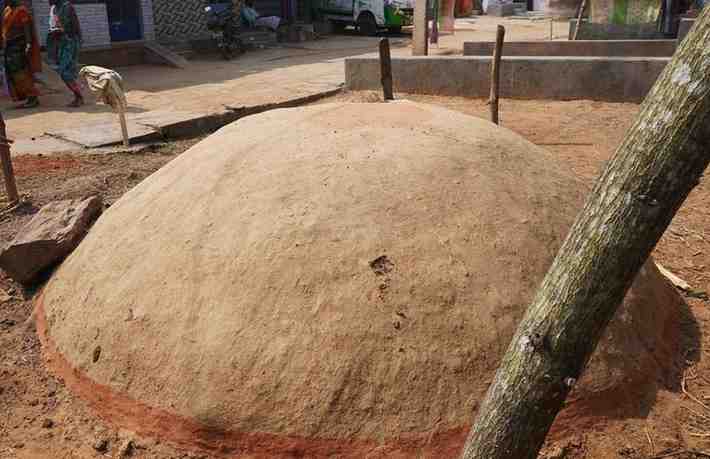
A Ritual Rooted in Land and Memory
On the misty days preceding Sankranti, remnants of an age-old agrarian ritual still surface in parts of north coastal Andhra Pradesh. In Jalantara Saasanam , a small village in Srikakulam district , farmers continue—though in dwindling numbers—to consecrate their Paathara , a traditional underground grain storage system. Practised along the banks of the Mahendratanaya River , the ritual reflects a deep interweaving of agriculture, faith, and household food security.
What is Paathara or Khoni?
Locally known as Paathara in Telugu and Khoni in Odia, the system consists of a rectangular pit dug into the earth, lined with straw and clay, and sealed with cow dung. Designed to store paddy for household consumption until the onset of the next monsoon, Paatharas were traditionally built in front of thatched homes.
Historically, every paddy-growing household maintained a Paathara large enough to feed the family for an entire year. Its presence symbolised prosperity, food sufficiency, and the collective life of joint families.
Decline Amid Changing Rural Landscapes
The tradition has sharply declined over the past two decades. In Jalantara Saasanam—home to nearly 200 households—only two Paatharas were constructed this year. Expanding cement roads, concrete houses, and shrinking homestead spaces have pushed the practice to the fringes.
With limited room around modern houses, farmers now dig Paatharas near cattle sheds or on relatives’ land. Elderly villagers note that skills such as straw-rope weaving, pit layering, and seasonal sealing—once passed down informally—are rapidly disappearing.
Taste, Health, and Ritual Significance
Paddy stored in a Paathara is valued for its distinct taste and perceived health benefits . Slight discolouration during underground storage is believed to enhance flavour—an attribute absent in modern godown or bag storage systems.
Traditionally, the size of the Paathara reflected landholding size and family strength . Rice drawn from it was also reserved for rituals, including Talambraalu during weddings, symbolising fertility, abundance, and blessings drawn directly from the land.
Structural Constraints and the Last Holdouts
Today, Paathara survives only in scattered pockets across Kanchili , Sompeta , and Itchapuram mandals. Despite canal renovation support from National Bank for Agriculture and Rural Development , irrigation remains limited, confining paddy cultivation largely to the Kharif season.
As bullock carts, oxen, and thatched houses disappear, farmers fear Paathara may vanish too. For the few families still practising it, the tradition’s survival depends on whether the next generation chooses to carry forward this balance of ancestral wisdom and ecological sustainability.
Exam-Focused Key Points
-
Paathara (Khoni) is a traditional underground paddy storage system
-
Practised in north coastal Andhra Pradesh and south Odisha
-
Protects grain from moisture, rodents, theft, and contamination
-
Paddy stored is meant only for household consumption , not sale or seed
-
Month: Current Affairs - February 03, 2026
Category: Agriculture | Food Security