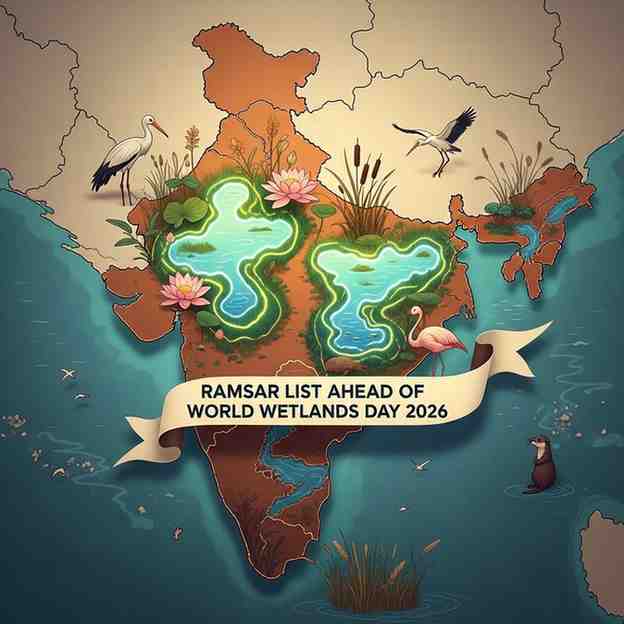
India’s Growing Global Wetland Footprint
India has further strengthened its commitment to wetland conservation with the inclusion of two new wetlands in the Ramsar List of Wetlands of International Importance. The announcement was made ahead of World Wetlands Day (2 February 2026) by Bhupender Yadav , Union Minister for Environment, Forest and Climate Change, through a post on social media platform X.
The new designations underline India’s sustained policy focus on biodiversity protection and ecological sustainability under the Ramsar framework.
Newly Designated Ramsar Sites
The two wetlands added to the Ramsar list are:
-
Patna Bird Sanctuary in Etah district, Uttar Pradesh
-
Chhari-Dhand in Kutch district, Gujarat
With their inclusion, India’s Ramsar site count has risen further, reinforcing the country’s position among the world’s leading nations in wetland conservation.
Rapid Expansion of India’s Ramsar Network
The Environment Minister highlighted that under the leadership of Narendra Modi , India’s Ramsar network has expanded by over 276% , increasing from 26 sites in 2014 to 98 sites at present .
This rapid expansion reflects a long-term national strategy focused on ecosystem protection, climate resilience, and sustainable development, while also enhancing India’s international environmental standing.
Ecological and Biodiversity Significance
Both newly designated wetlands are ecologically significant:
-
They provide critical habitats for migratory and resident bird species , including threatened and endangered varieties.
-
Beyond avifauna, these landscapes support diverse wildlife such as chinkara, wolves, caracal, desert cats, and desert foxes , especially in the arid ecosystem of Kutch.
Such wetlands play a vital role in maintaining regional biodiversity, supporting ecological research, and sustaining local livelihoods.
Ramsar Convention and India’s Role
India is a Contracting Party to the Ramsar Convention , formally known as the Convention on Wetlands of International Importance . The convention promotes the conservation and “wise use” of wetlands worldwide.
Designation as a Ramsar site does not imply ownership change but commits the country to maintain the ecological character of the wetland. India’s expanding Ramsar network highlights its proactive role in global environmental governance and wetland stewardship.
Exam-Focused Key Points
-
Ramsar Convention was signed in 1971 at Ramsar, Iran
-
India became a Ramsar signatory on 1 February 1982
-
Patna Bird Sanctuary and Chhari-Dhand are India’s latest Ramsar sites
-
India’s Ramsar sites increased from 26 (2014) to 98 (2026)
-
Month: Current Affairs - February 03, 2026
Category: Environment & Ecology | Biodiversity Conservation