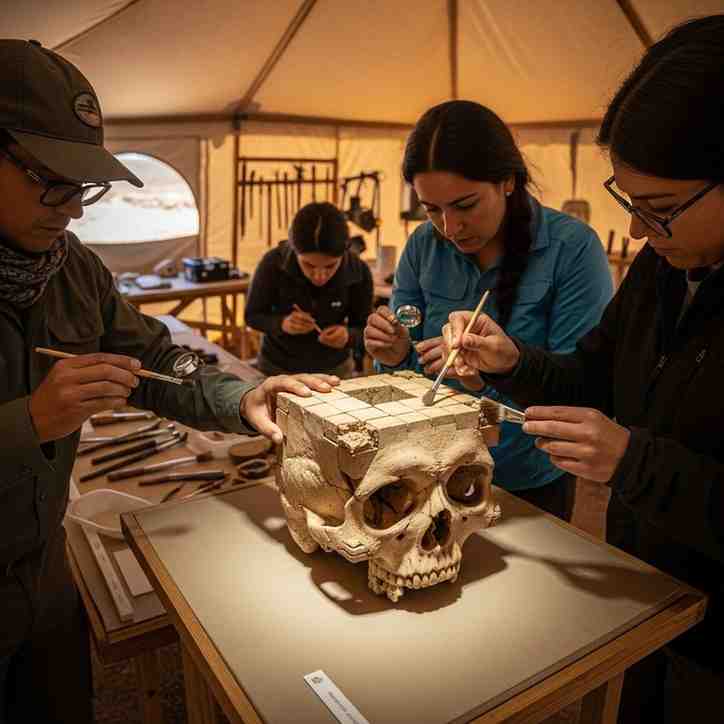
Ancient Mesoamerican Rituals Uncovered Through Unique Cube-Shaped Human Skull
Archaeologists in Mexico have uncovered a uniquely cube-shaped human skull , providing rare and striking evidence of an ancient cultural practice previously undocumented in the region. The discovery offers fresh insight into concepts of identity, ritual expression, and social organisation among pre-Hispanic communities of Mesoamerica.
Discovery in the Sierra Madre Oriental
The skull was discovered at the archaeological site of Balcón de Montezuma , located in the Sierra Madre Oriental. Osteological analysis indicates that the remains belonged to a man who lived over 1,000 years ago and died at around 40 years of age . Isotopic studies of his teeth and bones suggest that he spent his entire life in what is now modern-day Mexico, ruling out migration as a cause of the skull’s unusual shape.
Intentional Cranial Deformation Explained
Researchers confirmed that the cube-like appearance resulted from intentional cranial deformation , a practice carried out during infancy when skull bones are still malleable. By using boards, bindings, or bandages, caregivers gradually reshaped the head over time. While cranial modification was common across Mesoamerica, the parallelepiped or box-shaped form identified in this skull is markedly different from the more familiar elongated or conical styles seen in Maya and other cultures.
Cultural and Social Significance
Anthropologists believe cranial reshaping symbolised social identity, spiritual beliefs, and status . Modified skull shapes enhanced the visual impact of ceremonial headdresses and ornaments, helping individuals express group affiliation. The cube-shaped variant suggests a localised or group-specific tradition , highlighting cultural diversity within broader Mesoamerican practices.
What to Note for Exams?
-
The skull dates to the Mesoamerican Classic period (400–900 AD) .
-
Intentional cranial deformation was performed in early childhood .
-
The cube-shaped skull is a previously undocumented variant in the region.
-
The practice reflected social identity and ritual beliefs .
Broader Cultural Links
Similar flat-topped skulls elsewhere in Mesoamerica have been linked to ritual protection and symbolic “ensoulment.” Researchers suggest this find may point to cultural exchanges between the Huasteca region, Gulf Coast lowlands, northern Mexico , and possibly areas of the southern United States. However, the precise meaning of this rare cube-shaped form remains an active area of study.
Month: Current Affairs - December 22, 2025
Category: History, Archaeology