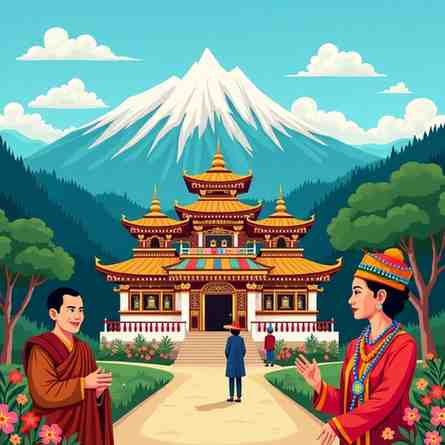
History of Sikkim
History Ancient and Medieval.
- The Namgyal dynasty had ruled Sikkim, which was founded in the 17 th century.
- Intimate relations with Tibet had an impact on the Buddhist traditions and monastery culture.
- Its medieval history was determined by constant territorial conflicts with Bhutan and Nepal.
Modern History and Merger with India
- Sikkim was a protectorate state to the British rule in 1861 as per the Treaty.
- Political instability and democratic uprisings increased after independence.
- After a referendum carried out in the year 1975 , Sikkim officially became the 22nd state in India .
Important Freedom Movements and Leaders
- The emergence of Sikhism State Congress demanded democracy.
- The first Chief Minister was called Kansas Lhendup Dorjee who was instrumental in the merger of Sikkim and India.
Geography of Sikkim
Physical Features and Climate
- Area: 7,096 sq. km (the second smallest state in India).
- Borders: Nepal (west), Bhutan (east), Tibet (north); West Bengal (south).
- The climate is tropical in the lower valleys and tundra in the high country.
Rivers, Lakes, and Glaciers
- The Japaneese saying is quite true in this Hamlet on the banks of Teesta .
- LAKES : Tsomgo (Changu lake), Gurudongmar Lake & Khecheopalri Lake(so sacred).
- The Zemu Glacier , among the biggest in the Eastern Himalayas, is the source of waters for Teesta.
Flora, Fauna, and National Parks
- Orchids, rhododendron and other alpine flora are the specialties of this route.
- Flora and fauna: Notable animal species include Red Panda (state animal), Snow Leopard, and Himalayan Black Bear .
- Khangchendzonga National Park a Unesco World Heritage site.
Sikhism Polity and Government.
Constitutional Status
- Joined India as the 22 nd state in the year 1975 .
- Article 371F provides special provisions that protect the cultural and political rights of the Sikkimese.
The State Government and Administration.
- Governor as the head of the constitution.
- Single chamber Legislative Assembly 32 seats.
- The executive branch is headed by Chief Minister.
Panchayati Raj and Local Self-Government.
- The institutions of Panchayati Raj have active operations in the rural regions.
- Municipalities and development boards are dealt with by urban local bodies.
Economy of Sikkim
Agriculture and Cash Crops
- Major crops: cardamom, ginger, oranges and paddy.
- The greatest producer of cardamom in India is Sikkim .
Tourism and Hydro Power
- The state GDP includes a great portion of tourism.
- Attractions: Nathula Pass, Yumthang Valley, Rumtek Monastery.
- The Teesta River hydropower projects increase the energy production.
Sustainable Development and organic farming.
- Sikkim was the first state to be full organic in India in 2016.
- Enhances environmental-friendly agriculture and sustainability.
Culture and Society of Sikkim
Languages, Religions, and Communities
- Languages: Nepalese, Bhote (Tibetan language), Lepcha (official) as well as English and Hindi.
- Main religions: Hinduism and Buddhism, as well as Christian and indigenous beliefs.
- Population: Lepchas (indigenous), Bhutias, and Nepalis.
Festivals and Fairs
- Losar (Tibetan New Year), Saga Dawa and Pang Lhabsol are notable Buddhist festivals.
- Hindu festivals, such as Dashain and Tihar are very popular.
Art, Music, and Handicrafts
- The traditional music comprises popular folk tunes in Nepali and Bhutia.
- Cottage industries: wood carving, thangka painting and carpet weaving.
Sikkim science, technology and environment.
Environmental Policies and Environmental Problems.
- The common problems include landslides, earthquakes and soil erosion.
- There are stringent anti-forest and anti-wildlife laws in the state.
Biodiversity Conservation
- Known as a bio diverse hot spot with alpine and sub-tropical ecosystems.
- Some of the conservation efforts involve eco-tourism and wildlife reserves.
FAQs on Sikkim GK for PCS
Q1. What is the capital of Sikkim?
Gangtok is the capital of Sikkim.
Q2. Who was the first Chief Minister of Sikkim?
Kazi Lhendup Dorjee.
Q3. Which is the state animal of Sikkim?
The Red Panda.
Q4. When did Sikkim become a state of India?
In 1975 , after a referendum.
Q5. Which is the highest peak in Sikkim?
Kangchenjunga, the third highest peak in the world .
Month: Current Affairs - Sep 17, 2025
Category: Sikkim PCS- GK