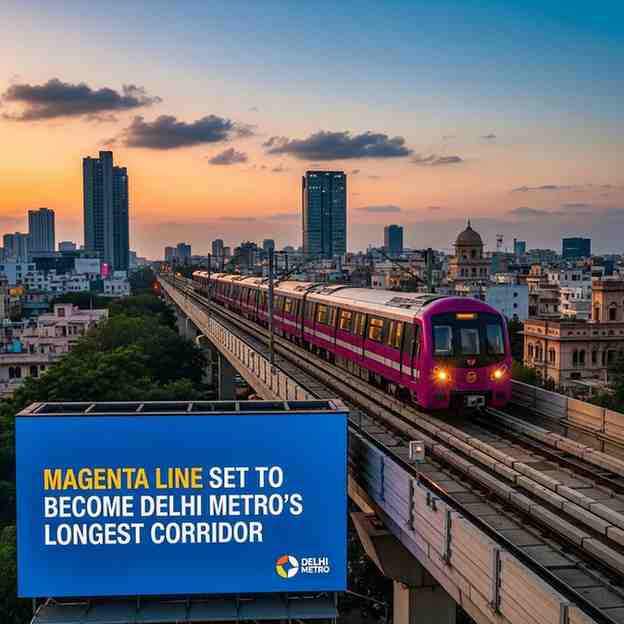
Phase-IV and Phase-V Expansions Transform Line-8 Connectivity
The Delhi Metro Rail Corporation is poised to make the Magenta Line the longest corridor in the Delhi Metro network upon completion of Phase-IV and Phase-V (A) expansions. The integrated extensions are designed to enhance cross-city mobility and strengthen Delhi-NCR transit efficiency.
Expansion and Corridor Length
With the newly sanctioned Ramakrishna Ashram Marg–Indraprastha extension via Central Vista under Phase-V (A), and the Indraprastha–Inderlok segment from Phase-IV functioning as a continuation, the Magenta Line will stretch from Botanical Garden (Noida) to Inderlok (Delhi). The corridor’s total length is projected at approximately 89 kilometres , establishing it as the network’s longest line. The entire route is planned for driverless operations , reflecting Delhi Metro’s growing reliance on automation technologies.
Interchange Connectivity
Post-expansion, the Magenta Line will host 21 interchange stations , the highest in the system. The operational section currently includes key interchanges at Botanical Garden, Kalkaji Mandir, Hauz Khas, and Janakpuri West. Future additions such as Central Secretariat, New Delhi, Azadpur, and Inderlok will emerge as triple interchange hubs , enabling high-density passenger transfers and reducing travel fragmentation.
Engineering Characteristics
The completed corridor will include 65 stations , with 40 underground , making it one of the most tunnel-intensive stretches. The line incorporates notable engineering records:
-
Haiderpur Badli Mor – highest elevated station (≈28.36 m rail height)
-
Hauz Khas – deepest underground station (≈29 m depth)
Urban Mobility Impact
The extended corridor is expected to redistribute passenger loads, reduce congestion on parallel lines, and improve end-to-end travel efficiency across Delhi-NCR.
Exam-Focused Points
-
Magenta Line projected length: ~89 km
-
Total stations after expansion: 65
-
Underground stations: 40
-
Driverless operations use CBTC technology
-
Highest interchange count: 21 stations
Month: Current Affairs - Feb 12, 2026
Category: Urban Infrastructure | Transport Systems