A rare interstellar object under scientific focus
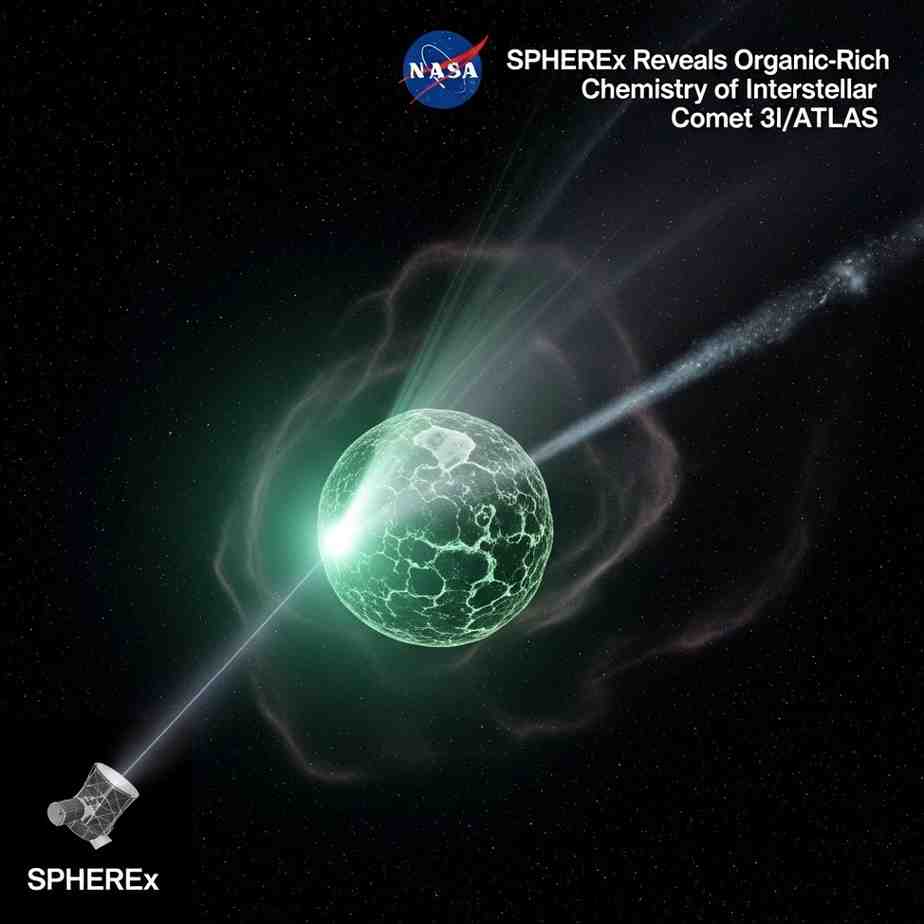
NASA’s SPHEREx space telescope has provided fresh insights into 3I/ATLAS , only the third confirmed interstellar comet ever observed passing through the solar system. Observations carried out in December 2025 revealed complex chemistry and unexpected activity, offering scientists a rare opportunity to study material that formed far beyond the Sun’s influence.
Infrared detection of organic molecules
Using its wide-field infrared instruments, SPHEREx detected a diverse mix of organic molecules in the comet, including methanol, methane, and cyanide. While such compounds are associated with biological processes on Earth, scientists stress that they can also arise through abiotic chemical reactions in cold interstellar environments. Their presence strengthens the view that complex organic chemistry is widespread in the galaxy.
Delayed brightening and unusual activity
Researchers observed a sharp rise in the comet’s brightness nearly two months after perihelion , its closest approach to the Sun. This delayed response is attributed to sublimation , where deeply buried ices gradually warmed and transitioned directly from solid to gas. The escaping gases formed a dense coma rich in water vapour, carbon dioxide, and carbon monoxide, signalling sustained internal activity rather than a brief surface reaction.
Glimpse of pristine subsurface material
The late-stage venting suggests that ancient, untouched ices were released from beneath the surface—material likely preserved for billions of years in interstellar space. Scientists also identified carbon-rich dust, soot-like particles, and unusually large solid fragments, indicating that 3I/ATLAS is ejecting heavier material than most solar system comets. This provides rare insight into the internal composition of objects formed around other stars.
Important Facts for Exams
-
SPHEREx observes the universe in 102 infrared wavelengths
-
Interstellar comets originate outside the solar system
-
Sublimation is the direct transition from ice to gas
-
Organic molecules can form through non-biological (abiotic) processes
Mission context and scientific significance
Launched in March 2025 and managed by NASA ’s Jet Propulsion Laboratory, SPHEREx is designed to map the cosmos and trace the distribution of organic compounds. 3I/ATLAS , first detected in July 2025 by the ATLAS telescope in Chile, was confirmed as interstellar based on its extreme speed and trajectory. Scientists say such fleeting visitors act as natural probes of distant star systems , and SPHEREx demonstrates how all-sky infrared missions can capture these rare cosmic encounters.
Month: Current Affairs - February 07, 2026
Category: Space Technology | Astronomy