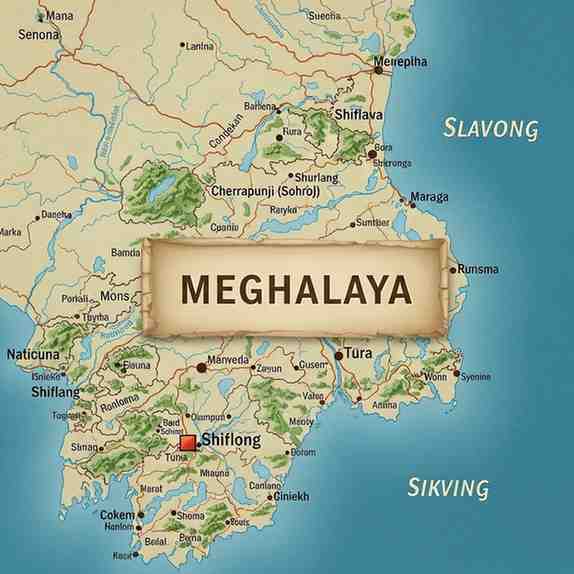
| Topic |
Detail |
| Statehood / Formation date |
21 January 1972 |
| Capital city |
Shillong |
| Area |
22,429 sq. km |
| Major tribes |
Khasi, Jaintia, Garo |
| Principal languages |
Khasi, Jaintia (Pnar), Garo, English |
| Economy base |
Agriculture + Horticulture + Forestry / Wood products |
| Notable natural features |
Umiam Lake, Living Root Bridges, rivers like Umngot River, hill terrain, high rainfall |
| Protected areas / Biodiversity hotspots |
Nokrek Biosphere Reserve / National Park, wildlife sanctuaries, rich flora/fauna |
Population, Language & Society
-
Population (2011 census): ~ 29.66 lakh.
-
Main tribes / communities:
-
Khasi people
-
Jaintia people
-
Garo people
These three tribes together constitute a large majority of the population.
-
Languages: Khasi, Pnar (Jaintia), Garo, along with English (used for official / educational purposes) are principal languages.
-
Social structure: Traditional tribal social systems; many communities follow matrilineal customs (inheritance, lineage) — especially among Khasi & Jaintia tribes.
Nature, Geography & Biodiversity
-
For its hilly terrain, Meghalaya is known for heavy rainfall , lush greenery, hills, waterfalls, caves, rivers, forests and biodiversity.
-
Famous places / natural landmarks:
-
Umiam Lake (a reservoir near Shillong)
-
Pristine rivers — e.g. Umngot River (in West Jaintia Hills / near Dawki) known for crystal-clear waters.
-
Forests & wildlife: State has several protected areas — national parks, wildlife sanctuaries, biosphere reserves. Example: Nokrek National Park / Biosphere Reserve (Garo Hills), important for biodiversity.
-
Cultural & natural uniqueness: Famous “Living Root Bridges” (root-grown bridges made by Khasi people) — a testament to traditional ecological engineering and Meghalaya’s harmony with nature.
History & Political Background
-
Earlier part of undivided Assam; region had tribal autonomy under Assam which had special status.
-
Became an autonomous state (within Assam) in 1970.
-
Gained full statehood on 21 January 1972 , forming the present state of Meghalaya (Khasi Hills + Jaintia Hills + Garo Hills).
Economy & Agriculture
-
Agriculture and allied activities form the backbone of Meghalaya’s economy: a large portion (about 80% of people ) depend on agriculture.
-
Major crops & produce:
-
Rice , Maize are staple crops.
-
Horticulture & cash crops: Potato, Turmeric, Ginger, Mustard/Rapeseed, Black pepper, Areca nut (betel nut), Tapioca , etc.
-
Also produce: Cashew, Strawberries, Tea, Coffee, Orchids, Mushrooms — benefitting from favourable climate and forested terrain.
-
Forestry & wood-based industries are also significant. Some mineral reserves exist (e.g. mica, minerals) though geography & environment pose constraints.
Culture, Tribes & Festivals
-
Rich tribal culture with unique traditions, languages, social structure (matrilineal among Khasi & Jaintia), crafts, folk arts.
-
Prominent tribes: Khasi, Jaintia, Garo.
-
Some notable festivals:
-
Wangala Festival — celebrated by Garo tribe (harvest festival / thanksgiving)
-
Traditional dances, music, crafts — strong tribal identity & heritage.
Month: Current Affairs - Dec 08, 2025
Category: