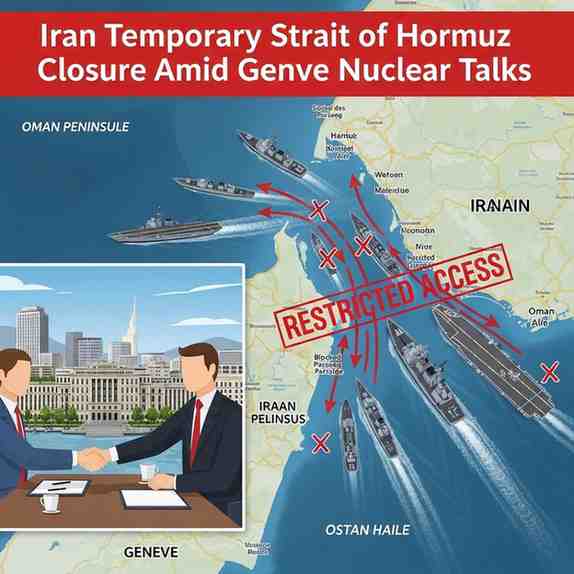
Live-Fire Drills and Diplomacy Shape Iran–US Nuclear Standoff
Iran briefly announced the closure of the Strait of Hormuz during live-fire military exercises, coinciding with renewed indirect nuclear negotiations with the United States in Geneva. Tehran described the move as a precautionary safety measure, yet the development drew global attention given the strait’s critical role in international energy trade.
Strategic Importance of the Strait
The Strait of Hormuz remains one of the world’s most vital maritime chokepoints. A significant share of global petroleum shipments transits this narrow corridor linking the Persian Gulf to the Gulf of Oman and the Arabian Sea. Even temporary disruptions carry implications for global oil prices and energy security
Live-Fire Drills and Strategic Messaging
Iranian state media reported that Revolutionary Guard units launched live missiles toward designated zones near the strait, declaring it closed for several hours over maritime safety concerns. Observers interpreted the exercises as calibrated signalling rather than operational blockade.
Supreme Leader Ayatollah Ali Khamenei issued warnings emphasising Iran’s readiness to counter perceived threats. Analysts noted that such demonstrations often serve dual purposes: reinforcing domestic resolve and projecting deterrence externally.
Geneva Talks and Diplomatic Dynamics
The military drills unfolded alongside indirect Iran–US discussions mediated by Oman. Iran’s Foreign Minister Abbas Araghchi later adopted a more conciliatory tone, expressing cautious optimism for a negotiated settlement.
The United States delegation was led by senior envoys engaging through intermediaries. Despite limited progress, negotiations continue to centre on uranium enrichment limits, stockpile reductions and verification frameworks. Tehran maintains that its nuclear activities are peaceful, while Washington seeks binding assurances against weaponisation.
Military Posture and Market Response
Parallel to diplomatic engagement, the United States has strengthened its regional naval presence. Financial markets reacted with measured volatility; oil prices softened after talks concluded, suggesting restrained investor expectations.
Important Facts for Exams
-
Strait of Hormuz links the Persian Gulf with the Gulf of Oman.
-
Roughly 20% of global oil trade passes through the strait.
-
Uranium enriched to 90% is weapons-grade.
-
Oman frequently mediates Iran–US diplomacy.
The episode highlights the delicate interplay between military signalling and diplomatic negotiations in West Asia, where energy security and nuclear concerns remain tightly intertwined.
Month: Current Affairs - Feb 18, 2026
Category: