Isro Moves to Revive a Critical Earth Observation Mission
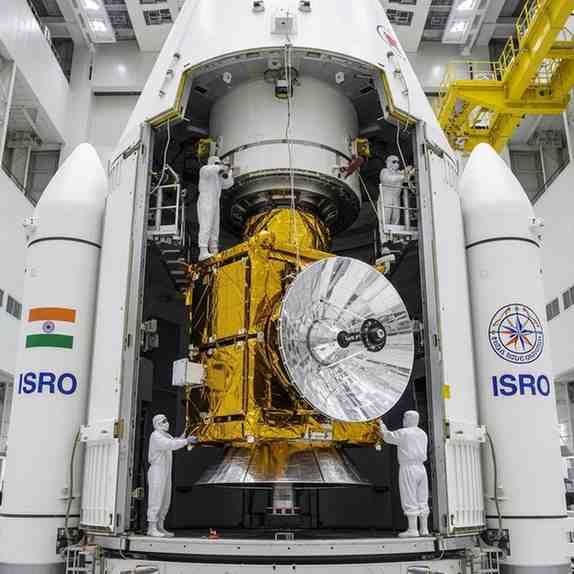
More than four years after a failed launch disrupted India’s geo-imaging plans, the Indian Space Research Organisation (Isro) is preparing to launch Gisat-1A , also designated EOS-05 . The satellite is a replacement for EOS-03 (Gisat-1) , which failed to reach orbit in 2021, and is expected to arrive soon at India’s spaceport for final launch preparations.
Background: From Setback to Recovery
The Gisat programme suffered a major setback on 12 August 2021 , when the GSLV-F10 mission failed due to a cryogenic upper-stage anomaly , preventing EOS-03 from achieving geostationary orbit. The launch had already faced two postponements in 2020 and early 2021 due to technical concerns.
Since then, Isro has carried out extensive design reviews, system-level checks, and validation exercises to ensure higher mission reliability. Gisat-1A represents the culmination of these corrective efforts.
Capabilities and Strategic Importance
Weighing about 2.2 tonnes , Gisat-1A is designed to operate from geostationary orbit , enabling frequent and near real-time imaging of large areas of the Indian region.
Key applications include:
-
Agriculture and crop monitoring
-
Forestry and mineral exploration
-
Disaster management and early warning
-
Oceanography, snow and glacier studies
-
Cloud and atmospheric property analysis
Although classified as a civilian satellite, its all-weather, cloud-free imaging capability gives it strong strategic relevance , supporting operational planning and situational awareness for India’s armed forces.
Launch Preparations and Expected Timeline
The satellite has completed major integration and testing milestones at the UR Rao Satellite Centre , Bengaluru. According to Isro Chairman V Narayanan , the spacecraft is currently under final technical review.
Once cleared, it will be transported to the Satish Dhawan Space Centre . A Notice to Airmen (NOTAM) has already been issued for the GSLV-F17 mission, indicating a tentative launch window between February 20 and March 5 .
Learning From Recent Launch Challenges
Isro’s cautious approach is shaped by recent launch setbacks, including two PSLV failures that resulted in the loss of EOS-09 (RISAT-1B) and DRDO’s Anvesha (EOS-N1) . These missions were also strategically significant.
Since the 2021 cryogenic-stage failure, however, GSLV has completed four consecutive successful missions , including the launch of the NISAR satellite in July 2025.
The Gisat-1A mission is therefore seen as a confidence-restoring test for India’s heavy-lift launch capability and a key milestone in strengthening the country’s Earth observation roadmap.
Exam-Focused Key Points
Month: Current Affairs - February 06, 2026
Category: Space Technology | Disaster Management