Bihar’s Mobile AI Voting Platform Marks Digital Election Innovation
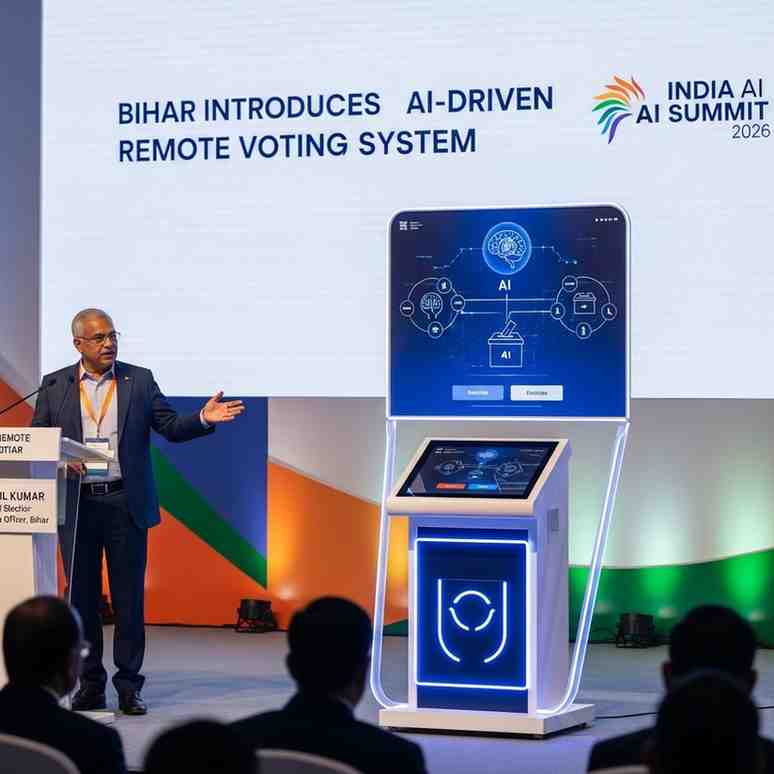
Artificial intelligence has made a notable entry into India’s electoral processes, with Bihar showcasing a mobile-based AI-enabled remote voting system at the India AI Impact Summit 2026. Presented by the Bihar State Election Commission, the initiative represents a digital governance innovation designed to enhance voter accessibility. The platform was first utilised during the 2025 urban local body elections and is being considered for broader deployment in future Assembly polls.
India’s First Mobile-Enabled Remote Voting Platform
Bihar’s framework is recognised as India’s first mobile-enabled remote voting mechanism. The Android-based application, “e-Voting SECBHR” , was developed by the Centre for Development of Advanced Computing (C-DAC) in collaboration with the State Election Commission. The system primarily supports voters facing mobility or location barriers, including migrant workers, students, senior citizens, pregnant women, persons with disabilities and medically unwell citizens. By allowing voting through personal smartphones, authorities aim to improve participation rates.
Verification and Technological Design
The voting procedure involves multiple verification layers. Users authenticate via OTP validation, followed by AI-based facial recognition and live selfie verification linked to the Electors Photo Identity Card (EPIC) database. The system integrates dual encryption, liveness detection and blockchain-backed storage to ensure data security. Votes are encrypted, anonymised and stored on a decentralised ledger. Decryption is enabled only after polling concludes through digital signatures and multi-factor authentication by authorised officials. Audit trails comparable to Voter Verifiable Paper Audit Trail (VVPAT) safeguards are also included.
Security Framework and Privacy Controls
Officials maintain that blockchain architecture ensures tamper resistance. Votes are de-identified before storage, separating voter credentials from ballot choices. Counting requires Returning Officers’ Digital Signature Certificates and post-poll hash verification, preserving ballot secrecy.
Important Facts for Exams
-
EPIC stands for Electors Photo Identity Card.
-
Blockchain functions as a decentralised digital ledger.
-
C-DAC operates under the Ministry of Electronics and IT.
-
VVPAT enables verification of votes in EVMs.
Operational Challenges and Concerns
While layered safeguards exist, experts highlight risks such as impersonation, device-sharing vulnerabilities and biometric recognition errors. Limited Android-only availability also restricts universal access. Pilot phase data indicates functional feasibility alongside the need for technical optimisation.
Month: Current Affairs - February 19, 2026
Category: Polity & Governance | Elections