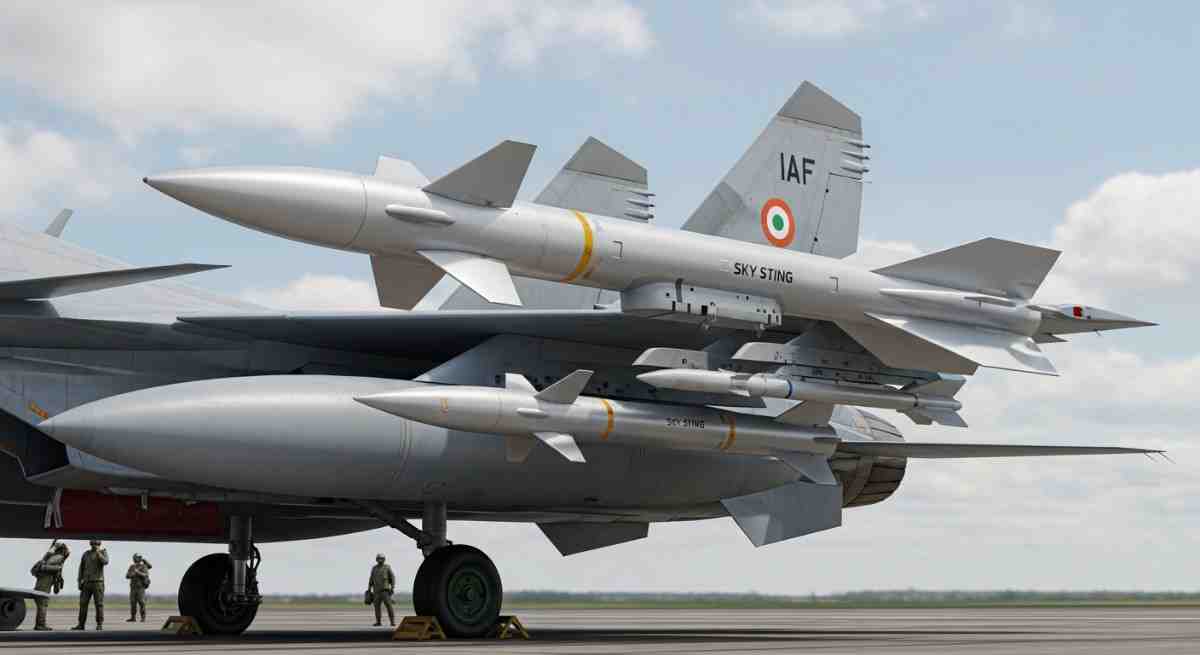
Sky Sting Missile May Boost Tejas Mk1A and Su-30MKI Combat Capability
As Narendra Modi undertakes his second state visit to Israel, India is advancing talks to acquire the Israeli-developed Sky Sting beyond-visual-range air-to-air missile (BVRAAM) for the Indian Air Force . The proposed induction is viewed as a capability enhancement amid evolving aerial challenges in the region.
Sky Sting: Technical Capabilities
The Sky Sting reportedly weighs between 180–200 kg, making it suitable for platforms such as the Tejas Mk1A while remaining compatible with the Su-30MKI. With an estimated engagement range of up to 250 km, it is designed to provide extended stand-off capability.
The missile uses a three-pulse solid-fuel rocket motor, enabling speeds beyond Mach 5. It features a radio-frequency seeker supported by AI-enabled target discrimination and strong resistance to electronic countermeasures. A two-way data link allows mid-course corrections and real-time pilot input.
Integration with Existing Systems
The missile is expected to integrate with the Israeli ELM-2052 AESA radar planned for the Tejas Mk1A. The IAF already operates several systems from Rafael Advanced Defense Systems , including I-Derby ER, Python-5, SPYDER air defence systems and SPICE precision-guided munitions.
Initial procurement may take place through direct acquisition, with possible local production arrangements under future collaboration frameworks.
Indigenous Programme Considerations
India’s Astra BVRAAM programme, developed by Defence Research and Development Organisation , continues to evolve. Astra Mk1 has a range of around 110 km, Mk2 is expected to exceed 200 km, and Mk3 aims for longer reach using solid-fuel ducted ramjet propulsion.
Experts note that selective imports can bridge capability gaps while domestic systems mature.
Important Facts for Exams
-
BVRAAMs engage targets beyond visual range (over 20–30 km).
-
AESA radars enable multi-target tracking with electronic beam steering.
-
Astra is India’s indigenous BVRAAM programme.
-
Solid-fuel ducted ramjet technology supports sustained high-speed flight.
With squadron strength below sanctioned levels, the potential acquisition reflects a calibrated approach—balancing immediate operational readiness with long-term self-reliance in defence manufacturing.
Month: Current Affairs - Mar 01, 2026
Category: Defence | Indian Air Force