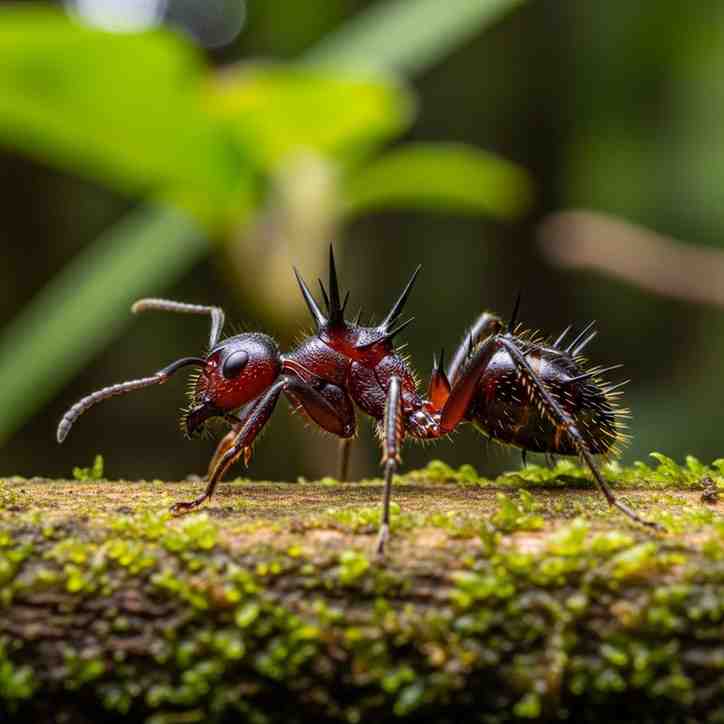
Rare Ant Species Identified Near Guwahati
A significant addition to India’s insect diversity has emerged from the Garbhanga Reserve Forest on the outskirts of Guwahati, where scientists have documented a previously unknown ant species. The finding demonstrates that forest patches located close to expanding urban centres can still host unique and scientifically valuable life forms.
Naming and Scientific Classification
The species has been formally described as Polyrhachis garbhangaensis , a member of the uncommon mucronata group of spiny ants. The research was published on January 30 in the journal Asian Myrmecology . The discovery was led by Ankita Sharma from the Animal Behaviour and Cognition Programme at the National Institute of Advanced Studies, Bengaluru, under the mentorship of Anindya Sinha. Naming the species after the Garbhanga landscape reflects the ecological importance of the site where it was first recorded.
Significance Within India’s Ant Diversity
The newly identified ant belongs to a specialised lineage that is rarely encountered in the country. It represents only the third documented species from the mucronata group in India. While more than seventy Polyrhachis species are known nationally, Assam alone hosts over twenty recorded taxa, underscoring the state’s status as a biodiversity hotspot for insect fauna.
Discovery Linked to Urban Ecology Research
Specimens were collected during fieldwork conducted in August 2023 within the approximately 117-square-kilometre Garbhanga Reserve Forest. This forest functions as an ecological corridor connecting Guwahati with the adjoining Rani Reserve Forest. The broader study examined how rapid urbanisation influences invertebrate communities, revealing that landscapes often considered degraded can still sustain rare species if core habitat features remain intact.
Distinct Morphology and Ecological Context
Measuring roughly 5.6 millimetres, the Assamese spiny ant is easily recognisable due to its bright yellow-orange abdomen, which contrasts with the darker coloration common among related species. Curved protective spines along its body likely serve as a defence against predators. Researchers also observed an ant-mimicking spider within the same habitat, indicating complex ecological interactions such as mimicry and predator–prey dynamics that contribute to ecosystem stability.
Exam-Focused Points
-
Polyrhachis garbhangaensis is a newly described species from the mucronata group of spiny ants .
-
The discovery occurred in Garbhanga Reserve Forest , which functions as a green corridor near Guwahati .
-
Assam hosts over 21 documented species of the genus Polyrhachis .
-
Ant diversity is widely used as an indicator of ecosystem health and habitat quality .
-
Urban-adjacent forests can still contain undocumented and rare biodiversity .
Month: Current Affairs - February 09, 2026
Category: Environment & Biodiversity