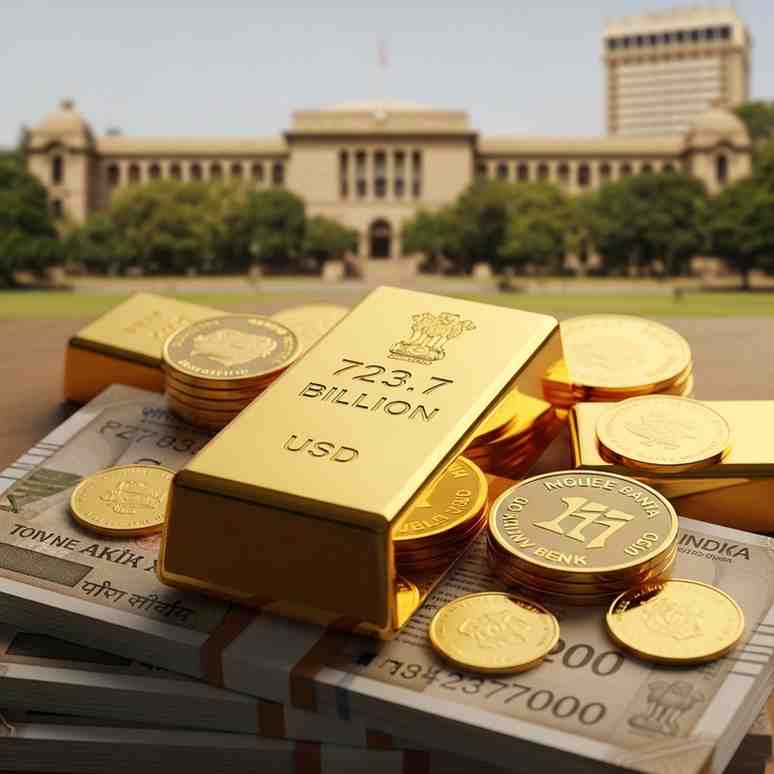
Record jump in India’s foreign exchange reserves
India’s foreign exchange reserves climbed sharply by $14.361 billion to touch a historic high of $723.774 billion in the week ending January 30, according to data released by the Reserve Bank of India . This follows an increase of $8.053 billion in the previous week, when reserves had already surpassed the earlier peak recorded in September 2024, highlighting sustained strength in the external sector.
Gold reserves drive the surge
The latest rise was largely driven by a sharp expansion in gold reserves. India’s gold holdings increased by $14.595 billion , reaching $137.683 billion . The increase reflects both valuation gains from higher global gold prices and the central bank’s strategy of gradually diversifying reserve assets to reduce dependence on foreign currency holdings amid global financial volatility.
Marginal fall in foreign currency assets
Foreign currency assets (FCAs), the largest component of the reserve basket, edged down by $493 million to $562.392 billion . FCAs fluctuate with changes in the value of major currencies such as the euro, pound sterling and Japanese yen against the US dollar. Despite the weekly decline, FCAs remain near record levels, providing a strong cushion against external shocks.
SDRs, IMF position and rupee movement
Special Drawing Rights (SDRs) rose by $216 million to $18.953 billion , while India’s reserve position with the International Monetary Fund increased by $44 million to $4.746 billion . During the same week, the Indian rupee recorded its strongest weekly gain in over three years, appreciating by about 1.4% , although it closed slightly weaker at ₹90.6550 per US dollar due to dollar outflows.
Important Facts for Exams
-
India crossed the $700 billion forex reserves milestone in September 2024
-
Gold is the second-largest component of India’s forex reserves after FCAs
-
SDRs are international reserve assets created by the IMF
-
High forex reserves improve resilience against balance-of-payments pressures
Policy context and economic relevance
The record reserve accumulation comes alongside the RBI’s decision to keep the repo rate unchanged at 5.25% and maintain a neutral policy stance. Elevated reserves enhance India’s ability to manage exchange rate volatility, reassure global investors, and support macroeconomic stability at a time of uncertain global financial conditions.
Month: Current Affairs - February 07, 2026
Category: Indian Economy | Monetary Policy