Living Relics and the Challenge of Modern Stewardship
The recent reunification of ancient gems associated with the corporeal remains of the historical Buddha—excavated more than a century ago at Piprahwa in present-day Uttar Pradesh—has revived a fundamental question for India’s cultural institutions: how should objects that are simultaneously archaeological artefacts and living objects of faith be cared for? Acquired from an overseas seller by an Indian conglomerate and handed over to the government, these relic-associated gems are now on public display in Delhi. What follows this exhibition will test India’s ability to reconcile modern museology with deeply rooted spiritual traditions.
Relics as presence, not symbolism
For Buddhist communities, relics linked to the Buddha are not symbolic representations but vessels of presence. In early Buddhist practice, physical proximity to the remains of the Buddha was believed to carry transformative power. Ash, bone fragments and associated offerings were divided and enshrined after his passing, giving rise to a sacred geography centred on stupas. Over time, colonial excavation and dispersal stripped many relics of this ritual context, reducing them to collectible antiquities. Their partial reunification in India is therefore significant not merely as an act of restitution, but as a restoration of meaning.
Early Buddhist practice and the logic of concealment
In early Buddhism, relics were rarely meant to be seen. They were sealed within reliquaries and placed at the heart of stupas, concealed from direct view. Devotional practice focused instead on circumambulation, meditation and ethical reflection around the structure that housed the relics. The power of the relic lay in its presence rather than its display. Visibility was secondary to context, restraint and ritual engagement.
Lessons from ancient sacred architecture
Ancient stupas, such as those preserved at Sanchi, illustrate how architecture mediated encounters with the sacred. The physical journey through gateways, railings and sculptural narratives prepared devotees mentally and emotionally before they approached the relic core. Stories from the Buddha’s life, scenes of worship and depictions of travellers from distant lands created a layered environment of instruction and reverence. Sacred architecture thus functioned as pedagogy, guiding visitors toward contemplation rather than consumption.
The danger of desacralised display
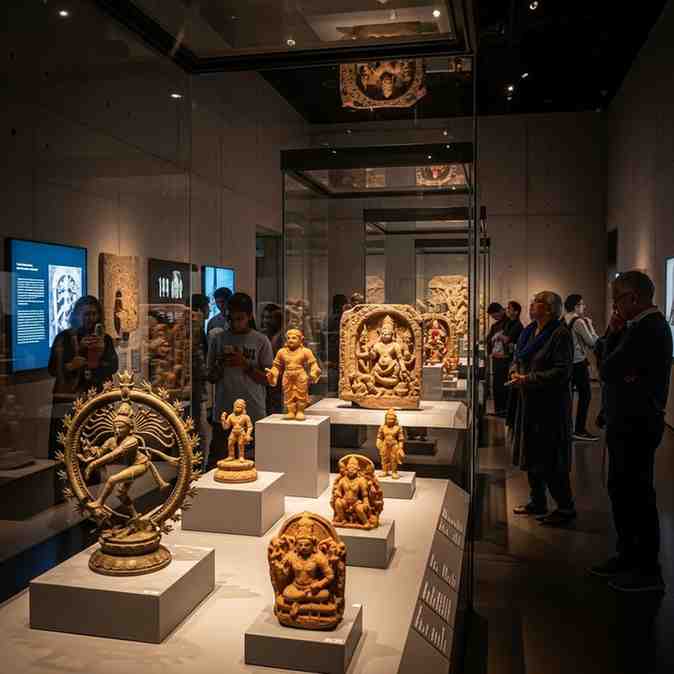
If the Piprahwa relic-associated gems are eventually housed in a conventional museum setting, there is a risk of repeating an older museological model that prioritises visibility over meaning. Sterile vitrines and explanatory labels may satisfy academic curiosity, but they flatten objects that were never meant to be experienced as isolated specimens. Such an approach risks desacralising living heritage and alienating communities for whom these relics remain spiritually potent.
Rethinking museums as spaces of encounter
The challenge before India is to reimagine museums not merely as repositories of objects, but as spaces of encounter. Institutions that house sacred heritage must allow for silence, reflection and sustained presence. Alongside scholarly interpretation, there should be room for quiet contemplation, ritual practice and emotional engagement. The aim is not to turn museums into places of worship, but to acknowledge that certain objects demand modes of engagement beyond observation.
Building institutional and social capacity
The return of the Piprahwa relics offers an opportunity to strengthen India’s broader heritage ecosystem. Interdisciplinary research involving historians, anthropologists, conservators and scientists can deepen understanding of how artefacts function as living entities within social worlds. Training programmes in ethical stewardship, restitution and community engagement can professionalise museum practice
Month: Current Affairs - January 21, 2026
Category: