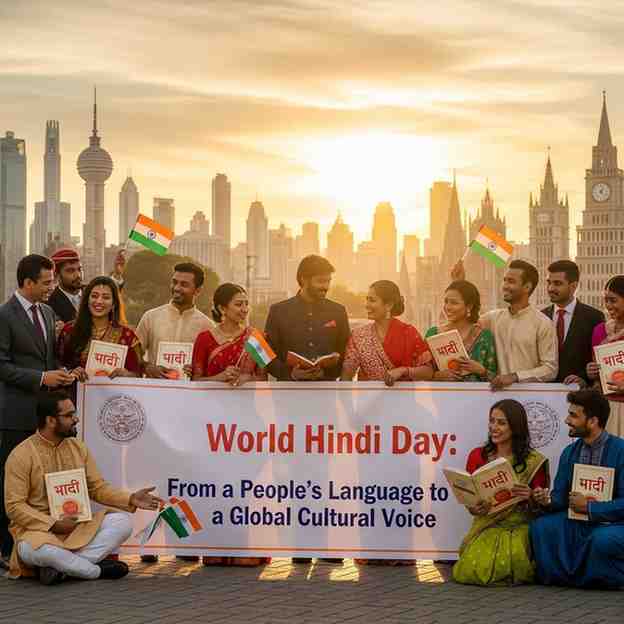
Languages are more than instruments of communication; they embody history, social struggle, and collective imagination. Hindi, today among the world’s most widely spoken languages, did not emerge through royal decree or institutional imposition. Its journey has been gradual, democratic and deeply rooted in popular life. Observed every year on January 10, World Hindi Day commemorates the First World Hindi Conference held in Nagpur in 1975, when Hindi was consciously projected as a global language. The occasion invites reflection on how a people’s language acquired international voice and relevance.
From classical roots to living speech
The origins of Hindi lie in Sanskrit , which over centuries interacted with Prakrit and Apabhramsha. These interactions produced regional dialects spoken by ordinary people rather than elites. Unlike court languages preserved by power, Hindi evolved organically through everyday use, absorbing local idioms, Persian and Arabic vocabulary, and later modern expressions. This openness ensured that Hindi remained a living, evolving language rather than a fossilised classical form.
The Bhakti movement and linguistic democratisation
A decisive moment in Hindi’s transformation came with the medieval Bhakti movement. Poets such as Kabir , Tulsidas , and Surdas consciously chose early Hindi over elite languages to reach the masses. Their verses carried spiritual messages, social critique and ethical reflection, challenging caste and religious hierarchies. Language became an instrument of inclusion, enabling faith and philosophy to reach beyond priestly or scholarly classes.
Hindi in the freedom struggle
During the colonial period, Hindi acquired political significance. In a linguistically fragmented society, it emerged as a medium of mass mobilisation. Mahatma Gandhi argued that political freedom without linguistic self-respect was incomplete, advocating Indian languages in public life. Leaders such as Jawaharlal Nehru , Subhas Chandra Bose , and Ram Manohar Lohia used Hindi to communicate nationalist ideas beyond English-speaking elites, ensuring the freedom movement resonated across towns and villages.
Literature as social conscience
Hindi literature matured alongside political awakening. Writers like Munshi Premchand exposed rural distress, caste inequality and moral conflict. Poets such as Mahadevi Verma and Jaishankar Prasad enriched Hindi with philosophical and aesthetic depth. Later, Harivansh Rai Bachchan brought emotional universality to modern Hindi poetry. Through literature, Hindi proved capable of expressing protest, romance, spirituality and modern existential concerns.
Hindi beyond India
Hindi’s influence has extended far beyond national borders. Scholars such as Max Müller highlighted the global significance of Indian languages. During the 20th century, translations of Hindi literature — especially Premchand’s works — reached audiences in Russia, Europe and East Asia. Today, universities across Asia, Europe and North America teach Hindi, recognising it as a language of cultural and academic engagement.
Conclusion
World Hindi Day is not merely ceremonial. It acknowledges Hindi’s journey from local speech to global voice while reaffirming its role as a link language within India’s linguistic diversity. Hindi’s strength lies in its inclusiveness and adaptability — its ability to coexist with other languages while engaging the modern world. Rooted in popular life and open to renewal, Hindi remains a living language capable of carrying both civilisational memory and contemporary aspiration.
Month: Current Affairs - January 10, 2026
Category: