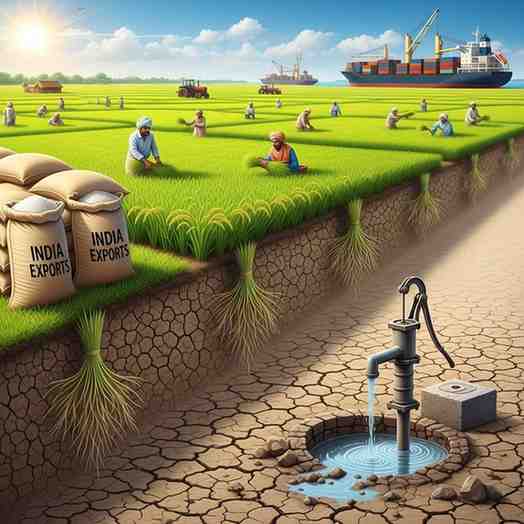
making reliance on deep aquifers riskier rather than safer.
Once groundwater levels fall below economically viable depths, entire farming systems can collapse, regardless of market prices or policy support. The resilience suggested by current export numbers may therefore be fragile, masking vulnerability rather than strength.
Are policy signals beginning to shift?
There are tentative signs of rethinking. Haryana has introduced a subsidy to encourage farmers to move away from rice toward less water-intensive crops such as millets. However, such incentives are typically short-term and insufficient to counteract decades of rice-centric policy signals.
Experts argue that meaningful reform must be structural and sustained. This includes long-term income assurance for alternative crops, gradual rebalancing of procurement and support away from water-intensive cereals, rationalisation of power subsidies to reflect groundwater scarcity, and the creation of reliable markets for diversified crops. Without these measures, farmers will rationally continue choosing rice, even as aquifers decline.
Reconciling food security with ecological security
India’s rice dominance highlights both its agricultural capacity and a deep contradiction in its policy framework. Food security policies designed for an era of scarcity are now driving ecological stress in an era of surplus. The challenge ahead is not merely technical but political: redesigning incentives so that farmers are rewarded for conserving water, not exhausting it.
If India continues on its current path, rising exports may coexist with sinking aquifers until the system reaches a breaking point. Sustainable leadership in global food markets will ultimately depend not on how much rice India can export today, but on whether it can protect the natural resources that make farming possible tomorrow.
Month: Current Affairs - January 03, 2026
Category: