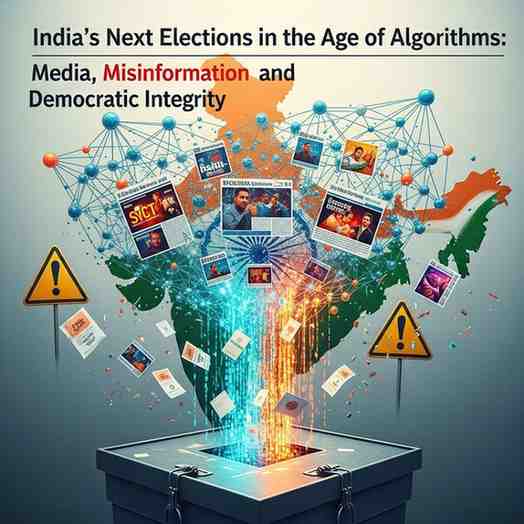
Elections in the Algorithm Age: Media, Misinformation and India’s Democratic Test
As India prepares for another round of Assembly elections in 2026, electoral politics is entering an increasingly complex phase. If the 2019 general election was labelled the first “WhatsApp election” and 2024 marked a decisive shift to digital-first campaigning, the upcoming polls promise a hybrid model—ground mobilisation fused with relentless online persuasion. This evolution has made media not merely a vehicle of politics, but one of its central battlegrounds, raising urgent questions about misinformation, influence, and democratic resilience.
From rallies to reels: the evolution of campaigning
Electioneering in India has always adapted to available media—from posters and loudspeakers to television debates. What distinguishes the present moment is the speed, scale and intimacy of digital platforms. With more than 90 crore internet users, political messaging today reaches voters through WhatsApp groups, Instagram reels, YouTube explainers, podcasts and influencer content. While the act of voting remains offline, political perceptions are now shaped overwhelmingly online.
Artificial intelligence has accelerated this shift. Campaigns increasingly rely on data analytics, micro-targeting and automated content generation. These tools lower costs and expand reach, but they also blur the line between organic persuasion and engineered influence.
Fake news: yellow journalism in digital form
Fake news is often described as yellow journalism amplified by algorithms. Though India lacks a statutory definition, it broadly refers to deliberately false or misleading information designed to advance political or economic agendas. Surveys by Pew Research Center show that nearly two-thirds of Indians view fake news as a major problem—among the highest levels globally.
Election periods intensify the threat. Data from the National Crime Records Bureau shows sharp spikes in fake-news-related cases during major polls. Political misinformation dominates this ecosystem, exploiting emotional triggers such as identity, nationalism and fear to maximise engagement.
Platforms, algorithms and virality
Social media platforms and messaging apps are the principal vectors of misinformation. Algorithms prioritise engagement, not accuracy, allowing sensational or polarising content to spread faster than verified information. Doctored videos, misleading headlines and out-of-context clips often achieve virality before fact-checks can catch up.
Traditional media still matters—television reaches crores of households—but digital consumption now dominates. Studies indicate that a majority of Indians access news primarily through platforms like YouTube, WhatsApp, Instagram and Facebook, even though print media continues to enjoy relatively higher trust. This asymmetry—high reach, lower accountability—creates fertile ground for manipulation.
Influencers as political intermediaries
A striking feature of contemporary campaigns is the rise of social media influencers as political intermediaries. Influencers, especially among Gen Z audiences, command trust that often exceeds that of traditional celebrities or politicians. Political parties have adapted by collaborating with podcasters, YouTubers and Instagram creators, while the Union government itself has institutionalised influencer outreach through official platforms.
This trend democratises access to audiences but also raises concerns about transparency. Sponsored political messaging often lacks clear disclosure, blurring the boundary between opinion and advertisement. In the absence of robust norms, influencer-driven politics risks becoming opaque persuasion.
Deepfakes and synthetic politics
The most destabilising development is the emergence of deepfakes—AI-generated audio and video that convincingly mimic real individuals. Recent elections have already seen synthetic videos of political leaders and celebrities circulating widely. AI-cloned voice calls to voters, personalised at scale,
Month: Current Affairs - January 18, 2026
Category: