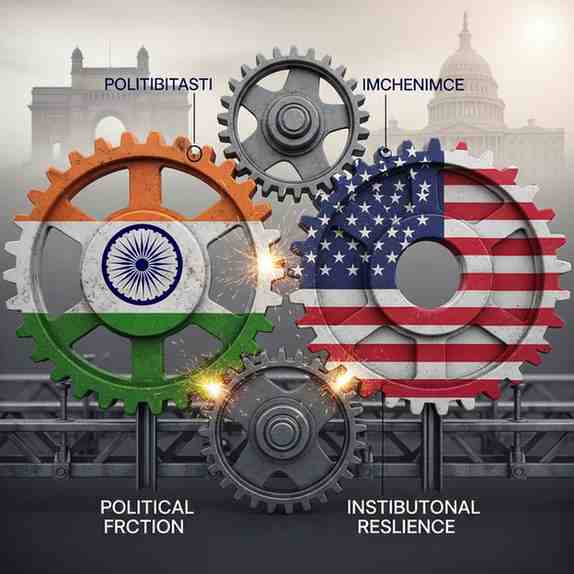
In 2025, India–United States relations present a complex and seemingly contradictory picture. On the surface, political ties appear strained, shaped by trade frictions, sanctions, and diplomatic unease symbolised by the postponement of the Quad Leaders’ Summit that India was expected to host. Yet beneath this turbulence lies a more stable and enduring reality: the institutional foundations of the bilateral relationship remain strong, functional, and steadily expanding.
This coexistence of political friction and institutional momentum explains why defence cooperation, technology partnerships, and high-level official engagements continue even when summit-level diplomacy slows.
Political headwinds and visible strain
The postponement of the Quad Leaders’ Summit became the most visible indicator of diplomatic discomfort. Though officially unexplained, it coincided with a broader set of challenges in India–US ties. These included higher U.S. tariffs on Indian goods, penalties linked to India’s continued purchase of Russian crude, and perceptions in New Delhi that Washington was pursuing a more pragmatic engagement with China that diluted Indian strategic sensitivities.
The economic impact of these tensions was tangible. India’s exports to the United States declined sharply in 2025, highlighting how trade disputes can quickly affect domestic industries. At the same time, Washington’s renewed engagement with Pakistan — including access to ports and cooperation on critical minerals — revived traditional Indian concerns. This engagement, driven largely by U.S. supply-chain and strategic calculations, reinforced the sense of uncertainty in New Delhi.
Despite these developments, U.S. officials consistently reiterated India’s strategic importance, indicating that current frictions reflect tactical adjustments rather than a fundamental shift in American policy.
Institutional depth beyond headline diplomacy
Against this backdrop, visits by India’s External Affairs Minister and senior military leadership to the United States took on greater significance. They highlighted an often-overlooked reality: India–US cooperation today is sustained less by political symbolism and more by institutional depth.
Bureaucracies, armed forces, scientific agencies, and regulatory bodies on both sides continue to interact through established mechanisms that function independently of summit calendars. This insulation allows cooperation to progress even during periods of political uncertainty.
The Quad: from summit-driven to system-driven
The Quad’s evolution in 2025 illustrates this institutionalisation. Its relevance did not depend on a single leaders’ summit. The Quad Foreign Ministers’ Meeting held in Washington in July 2025 launched initiatives across maritime security, counterterrorism, supply-chain resilience, critical technologies, and humanitarian assistance.
In December 2025, the Quad Counterterrorism Working Group met for the third consecutive time, reinforcing operational continuity. These engagements demonstrated that the Quad has matured into a functional platform whose momentum is sustained through working groups and sectoral cooperation rather than episodic high-level meetings.
Defence cooperation as the stabilising core
Defence remains the most stable pillar of India–US relations. Since the 2008 civil nuclear agreement, military and security cooperation has deepened steadily. This trajectory culminated in October 2025 with the signing of a new 10-year Defence Framework Agreement, aimed at enhancing coordination, intelligence sharing, and technological collaboration in the Indo-Pacific.
Regular joint exercises such as Yudh Abhyas, Tiger Claw, and the Malabar naval exercise continue to build interoperability and trust. These engagements create habits of cooperation that are largely insulated from political volatility.
A dense architecture of agreements
Over the past decade, India and the United States have built a dense web of enabling agreements covering logistics sharing, secure communications, geospatial intelligence, defence innovation, and supply-chain security. These frameworks embed cooperation into everyday military and industrial processes, making sudden political disengagement costly and impractical for both sides.
Technology collaboration has further reinforced this institutional bond. Major defence manufacturing agreements and joint space missions in 2025 created long-term interdependence, extending cooperation beyond security into civilian and developmental domains such as disaster management and infrastructure planning.
Expanding into infrastructure and regional capacity-building
The partnership has also expanded into infrastructure and connectivity. The Quad Ports of the Future Conference held in Mumbai in November 2025 brought together Indo-Pacific partners to discuss resilient and sustainable port development. This reflects a broader shift in geopolitics, where quality infrastructure has become a strategic tool and India–US cooperation increasingly supports regional capacity-building.
Month: Current Affairs - Jan 08, 2026
Category: