85% of land value for severe damage and 15% for diminution of land value. Yet in practice, implementation remains uneven, and disputes continue to stall projects.
Legal gaps exposed by conservation conflicts
Structural weaknesses in the legal framework were starkly highlighted by the Supreme Court in M.K. Ranjitsinh v Union of India , which examined the threat posed by overhead transmission lines to the endangered Great Indian Bustard. While the Court attempted to balance renewable expansion with conservation imperatives, the case exposed a deeper gap: the Electricity Act, 2003 does not address land acquisition for transmission lines.
As a result, transmission projects are forced to navigate a maze of overlapping laws — electricity regulation, land statutes, forest rules and wildlife protections — without a unified framework. This legal fragmentation increases uncertainty and slows execution.
Coordination as the central challenge
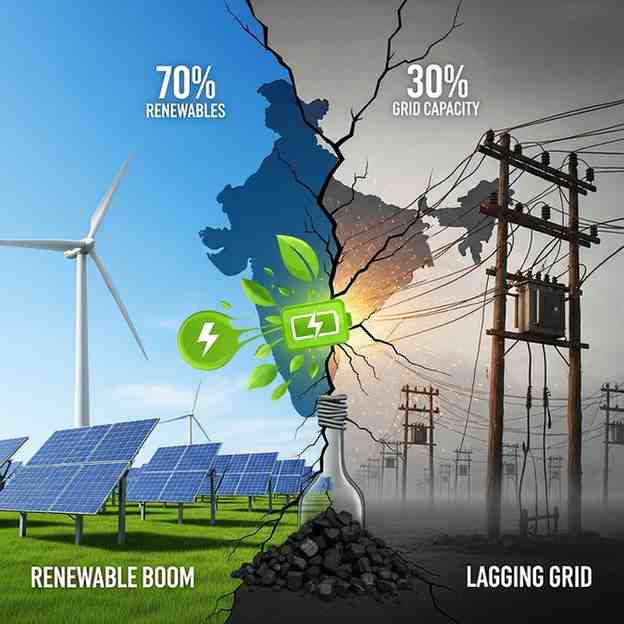
India’s renewable energy push is no longer constrained primarily by ambition, capital or technology. It is constrained by coordination. Generation capacity, transmission planning, storage deployment, environmental safeguards and state-level consent are all moving at different speeds and under different authorities.
Unless renewable capacity addition is synchronised with grid expansion, curtailment will continue to rise. Taking states into confidence, standardising RoW compensation, integrating environmental planning at the design stage, and aligning transmission timelines with renewable auctions are now indispensable.
Conclusion: megawatts are not enough
India’s green transition cannot succeed on megawatts alone. A grid that cannot carry clean power is as limiting as the absence of generation itself. Transmission infrastructure — often invisible in public discourse — has emerged as the critical constraint in achieving India’s climate and energy goals.
Resolving this challenge requires a shift from fragmented policy fixes to integrated planning, where renewable generation, transmission corridors, energy storage and social acceptance are treated as parts of a single system. Without this shift, India risks building vast clean energy capacity that never fully reaches consumers — turning a climate success story into a cautionary tale of infrastructure mismatch.
Month: Current Affairs - January 15, 2026
Category: