Transition Beyond the International Space Station
As the International Space Station (ISS) approaches the end of its operational life, the architecture of human presence in space is undergoing a fundamental shift. With plans in place for the ISS’s controlled deorbit around 2030 , space agencies are increasingly turning to commercial partners to maintain continuous activity in low Earth orbit (LEO) .
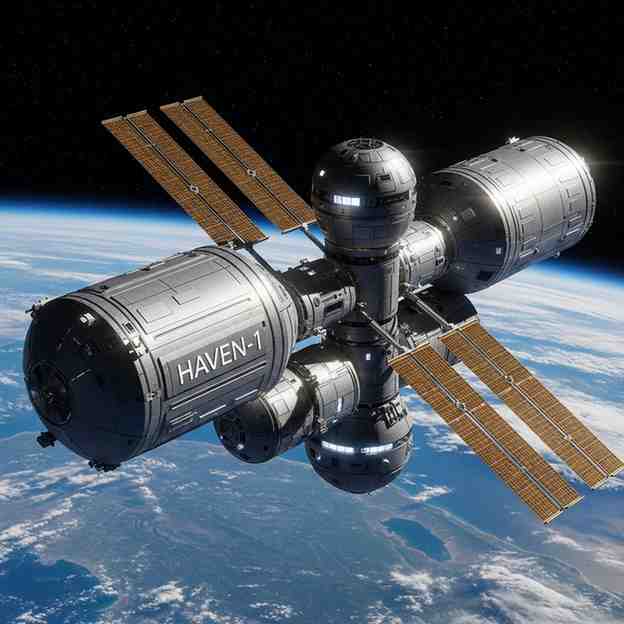
In this emerging landscape, Vast Space , a US-based private startup, has positioned itself at the forefront with Haven-1 , a compact commercial space station expected to become the first fully private orbital outpost .
Haven-1: A Private Alternative to Government-Led Stations
For more than two decades, the ISS has functioned as humanity’s permanent space laboratory, jointly operated by multiple national space agencies. Haven-1 represents a departure from this model, signalling a transition from state-owned infrastructure to privately built and operated stations .
Vast Space aims to offer Haven-1 as a commercial platform for research, technology demonstration, and future human missions, aligning with NASA’s long-term strategy of purchasing services rather than owning orbital assets.
Design Philosophy and Launch Timeline
Haven-1 has been designed as a single-module, compact space station , avoiding the complexity of multi-module assembly in orbit. This streamlined approach allows the station to be launched in one piece aboard a Falcon 9 rocket developed by SpaceX .
Although initially planned for 2026, the launch is now targeted for early 2027 . Vast Space has confirmed that the primary structure is already assembled , and the revised timeline remains stable.
Integration with Proven Space Systems
A defining feature of Haven-1 is its reliance on flight-proven systems rather than entirely new technologies. Once in orbit, the station will depend on the Crew Dragon capsule for:
-
Power supply
-
Life-support systems
-
Crew transport and emergency return
This strategy significantly reduces technical risk and shortens development timelines. The project team includes engineers with prior experience at NASA and SpaceX, further strengthening its technical credibility.
Important Facts for Exams
-
Low Earth orbit (LEO) lies roughly between 160 km and 2,000 km above Earth
-
Falcon 9 is a reusable launch vehicle developed by SpaceX
-
NASA plans to transition from owning space stations to buying commercial services
-
Haven-1 is designed as a single-module private space station
-
Commercial stations are central to the growing private space economy
Strategic Importance in the Post-ISS Space Economy
Vast Space
Month: Current Affairs - February 04, 2026
Category: Space Economy | Commercial Spaceflight