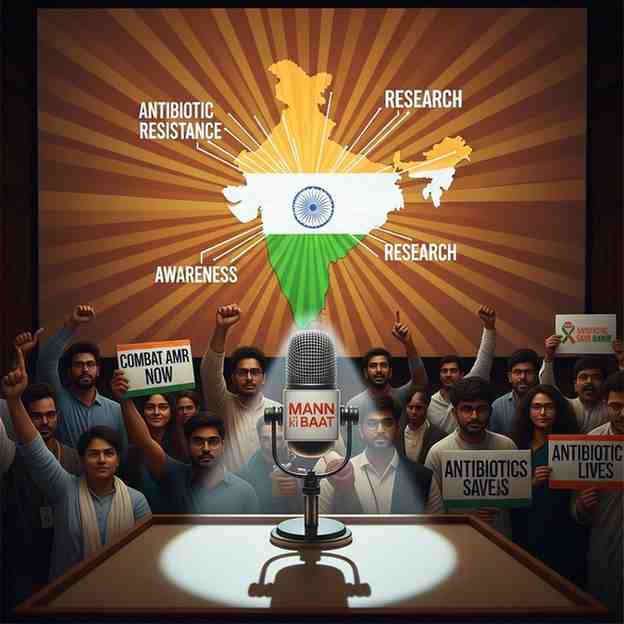
When Prime Minister Narendra Modi spoke about antimicrobial resistance (AMR) in the December 28, 2025 episode of Mann Ki Baat , he elevated a largely technical public-health concern into a subject of national conversation. For years, India’s AMR crisis has been acknowledged by experts but ignored by the public. Whether this intervention becomes a transformative moment or merely a symbolic warning will depend on how decisively recognition is converted into action.
Why the Prime Minister’s intervention matters
In the 129th episode of Mann Ki Baat , the Prime Minister described AMR as a “matter of concern”, citing evidence from the Indian Council of Medical Research that antibiotics are losing effectiveness against common infections such as pneumonia and urinary tract infections. More importantly, he identified the central driver of resistance in simple terms: the indiscriminate and thoughtless use of antibiotics by people.
By explicitly cautioning against self-medication and the casual belief that antibiotics are cure-alls, the Prime Minister reframed AMR from a clinical failure into a social and behavioural problem. This matters because AMR in India is not driven primarily by lack of drugs, but by how existing drugs are used, misused and overused.
Why AMR has failed to enter public consciousness
Despite India being one of the world’s largest consumers of antibiotics, AMR has remained confined to hospitals, academic journals and policy documents. Over-the-counter antibiotic sales, incomplete treatment courses and the use of antibiotics for viral infections are widespread, yet public awareness has remained low.
Even well-intentioned policy measures — such as the National Action Plan on AMR or restrictions on certain veterinary antibiotics — struggled to change behaviour because they never truly engaged households. The Prime Minister’s address breaks this pattern by carrying the message directly to citizens, bypassing institutional silos.
Awareness is necessary — but not sufficient
Mass awareness is indispensable in a crisis driven by behaviour, but it cannot stand alone. AMR today is a multi-sectoral problem involving human health, animal husbandry, agriculture, pharmaceutical manufacturing and the environment. Experts increasingly emphasise a “One Health” approach, recognising that resistance spreads across humans, animals and ecosystems.
Antibiotic use in livestock, pharmaceutical waste contaminating water bodies, and weak sanitation systems all contribute to resistance. Without coordinated action across these domains, behavioural change among patients alone will yield limited results.
The surveillance gap remains critical
Another major weakness lies in surveillance. India’s National AMR Surveillance Network feeds into the WHO’s global system, but coverage remains skewed toward tertiary government hospitals in urban areas. This risks overstating resistance while leaving large parts of community-level use invisible.
Experts have consistently argued for integrating private hospitals, primary health centres and non-urban facilities into surveillance. Without representative data, policy responses risk being blunt, reactive and poorly targeted.
From recognition to reform
The World Health Organization ’s Global Action Plan on AMR rests on five pillars: awareness, surveillance, infection prevention, rational use of antimicrobials, and sustained investment in innovation. The Prime Minister’s speech significantly advances the first pillar. The challenge now is political follow-through on the remaining four.
Conclusion
Mann Ki Baat may well mark the moment when India collectively recognised AMR as a national threat rather than a medical footnote. But recognition is only the beginning. If awareness is matched by surveillance expansion, regulatory enforcement and a genuine One Health strategy, this moment could bend India’s AMR curve. If not, it risks becoming a powerful warning remembered too late — in a future where common infections once again become deadly.
Month: Current Affairs - Jan 09, 2026
Category: