US President Donald Trump ’s renewed push to bring Greenland under American control has transformed a long-dormant geopolitical curiosity into a serious transatlantic crisis. Coming soon after a controversial US military operation that claimed the capture of Venezuelan President Nicolás Maduro , Trump’s remarks have unsettled allies, alarmed Denmark , and revived fears that raw power politics are returning to regions once governed by restraint and alliance norms.
Why Greenland suddenly matters
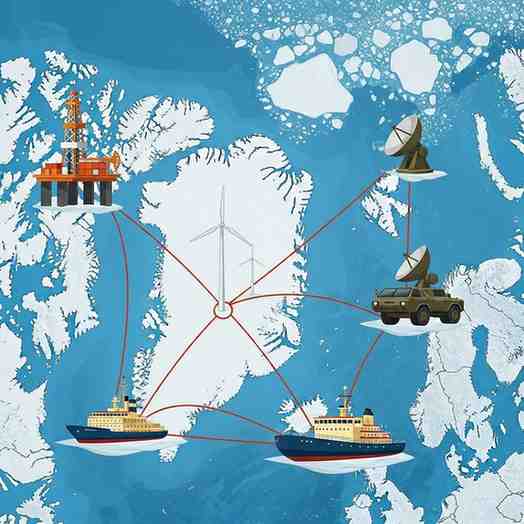
For much of modern history, Greenland remained peripheral to global politics — remote, sparsely populated, and protected by geography and diplomacy. Climate change and great-power rivalry have ended that isolation. As Arctic ice retreats, new shipping routes, military pathways and resource frontiers are opening, pulling Greenland into the centre of strategic calculations.
Trump’s claim that the United States “needs Greenland for national security” reflects this shift. The island lies between North America and Europe, making it central to missile early-warning systems and Arctic defence planning. The US already operates the Pituffik Space Base (formerly Thule Air Base), a critical node in space surveillance and missile detection, underscoring Greenland’s existing strategic value.
Defence, minerals and Arctic competition
Greenland’s importance extends beyond defence. Geological surveys indicate that the island contains many minerals classified as “critical” by Western economies, including rare earth elements vital for clean energy technologies, electronics and advanced weapons. With China dominating global rare-earth supply chains, Greenland has acquired new economic and geopolitical significance.
While Greenland has banned oil and gas exploration, its mining potential remains substantial. Although Trump frames his interest largely in security terms, the overlap between strategic minerals, defence autonomy and economic power is unmistakable.
A familiar ambition, a sharper edge
The US has sought Greenland before. It explored acquisition in the 19th century, expanded its presence during World War II, and in 1946 formally offered to buy the island — an offer Denmark rejected. A 1951 defence agreement nonetheless institutionalised a lasting American military footprint.
What distinguishes the current episode is not the idea itself, but the tone and context. Trump’s refusal to rule out coercive means, combined with recent US unilateral military actions elsewhere, has heightened anxieties that pressure could escalate beyond rhetoric.
Denmark, NATO and a dangerous precedent
Denmark has drawn a clear red line, insisting that Greenland is not for sale and warning that any attempt at annexation would shatter trust within North Atlantic Treaty Organization . For NATO, the implications are severe. The alliance rests on collective defence among sovereign equals; a member threatening another’s territory would create an unprecedented internal crisis.
European leaders have rallied behind Copenhagen, stressing that Arctic security must be managed collectively and in accordance with international law — not through unilateral assertion.
Greenlanders’ own voice
Greenland’s internal politics add complexity. While many Greenlanders aspire to eventual independence from Denmark, there is overwhelming opposition to becoming part of the United States. The dominant sentiment in Nuuk is that the island’s future must be decided by its people, not external powers.
More than an Arctic dispute
The Greenland episode reflects a broader global trend: the erosion of restraint as strategic geography, resources and military advantage eclipse long-standing norms of sovereignty. If pushed too far, the issue risks
Month: Current Affairs - January 08, 2026
Category: