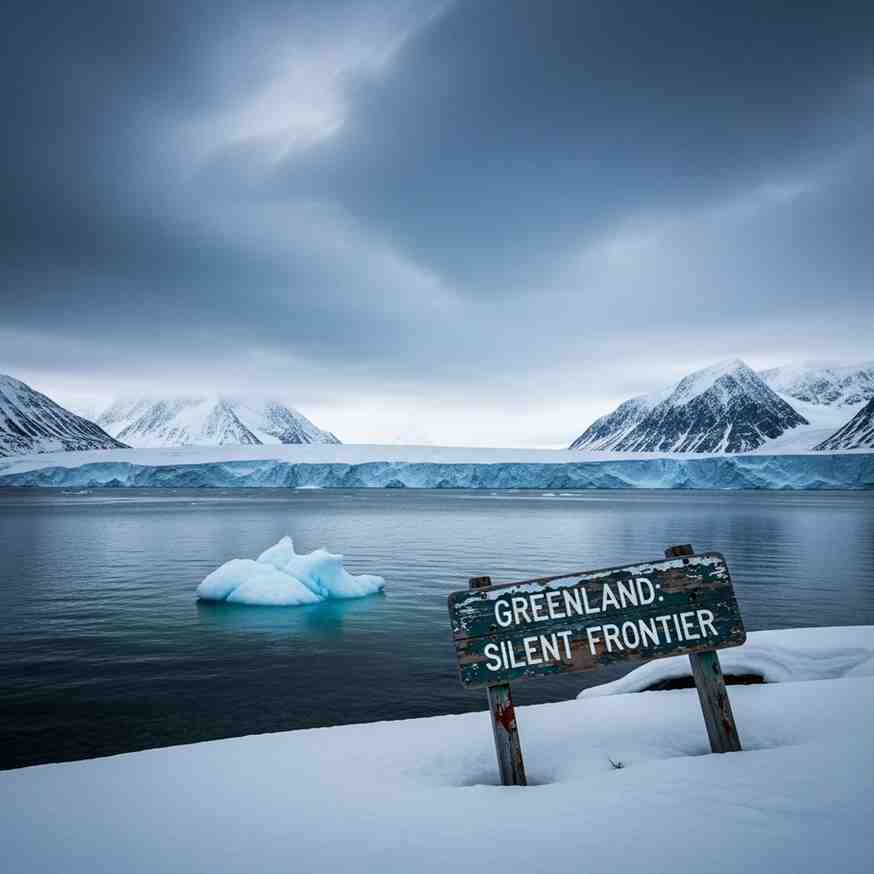
Greenland, Thule and the Logic of Power: When Strategy Overrides Sovereignty
On January 21, 1968, a United States Air Force B-52 bomber carrying four thermonuclear weapons crashed onto the frozen ice near Thule Air Base in Greenland. Officially, it was an accident—one of the many hazards of Cold War nuclear brinkmanship. In reality, the episode revealed a deeper and more troubling pattern: the subordination of sovereignty, transparency and Indigenous rights to strategic imperatives. More than half a century later, as Donald Trump speaks openly about acquiring Greenland, the Thule crash appears less an anomaly and more an early chapter in a continuing story of geopolitical entitlement.
The Thule Crash and the Politics of Secrecy
The bomber was part of Operation Chrome Dome, a US strategy that kept nuclear-armed aircraft continuously airborne to deter the Soviet Union. A fire onboard forced the crew to eject, and the aircraft slammed into the Arctic ice. While the nuclear warheads did not detonate, their conventional explosives did, dispersing plutonium across miles of ice and snow.
What followed was a massive clean-up operation conducted in extreme secrecy. Thousands of tonnes of contaminated ice were removed and shipped to the United States. Yet one key component of a thermonuclear weapon was never recovered, a reminder of how even “contained” nuclear incidents leave unresolved risks. Equally damaging was the diplomatic fallout. Denmark had publicly committed itself to a nuclear-free policy, yet had quietly allowed US nuclear operations over Greenland. The crash exposed this contradiction, forcing Copenhagen into uneasy damage control while Washington prioritised strategic continuity over accountability.
Colonial Displacement Before Nuclear Fallout
The Thule incident cannot be understood in isolation. Greenland’s experience of external control predates the Cold War. In 1953, Danish authorities forcibly relocated Inuit families from the Thule region to Qaanaaq to make way for the expanding US air base. The displacement severed communities from ancestral hunting grounds and disrupted cultural and economic life.
This was not an episode of sudden violence, but of administrative coercion—colonial power exercised through policy decisions that reshaped lives without consent. The nuclear crash occurred near lands that had only recently been taken from the Inuit, reinforcing the sense that Greenland’s territory existed primarily to serve external interests.
Control Beyond Territory: Reproductive Coercion
State control extended even into the bodies of Greenlandic women. During the 1960s and 1970s, Danish authorities implemented a population control programme in which thousands of girls and women were fitted with intrauterine devices or given hormonal contraception without informed consent. Many were minors. The programme, framed as public health policy, functioned as coercive social engineering.
Subsequent apologies and compensation schemes have acknowledged wrongdoing, but they cannot erase decades of physical harm, trauma and silence. Together with forced relocations, these practices reveal how governance over Greenland often meant management rather than partnership.
Why Greenland Was Strategically Indispensable
For Washington, Greenland was never peripheral. Its location made it vital for early-warning radar systems, nuclear deterrence and control over the North Atlantic. The 1951 US–Denmark Defence Agreement granted the United States extraordinary freedom of operation, effectively normalising American strategic primacy on Greenlandic soil.
Plans to lease or even purchase Greenland surfaced as early as the 1950s, not because they were legally feasible, but because they reflected an underlying assumption: that strategic necessity could override questions of sovereignty.
Trump’s Candour and an Old Logic
What distinguishes the present moment is not ambition, but bluntness. Trump’s remarks about acquiring Greenland discard the diplomatic euphemisms of the Cold War. Security is framed in terms of ownership, control and exclusion. Where earlier US policy relied on secrecy and alliance management, Trump articulates openly what had long been implicit.
This candour, however, does not make the logic new. It merely exposes it.
Sovereignty in an Unequal System
Denmark and Greenland have resisted such assertions, emphasising autonomy and self-determination. Yet structural constraints remain. Military alliances, geographic realities and power asymmetries limit the ability of smaller actors to assert meaningful choice. Indigenous voices, marginalised in 1953 and 1968, remain vulnerable when strategic narratives dominate.
Conclusion
The Thule crash was not simply a Cold War mishap. It was a moment when the hidden architecture of power became briefly visible—revealing how security doctrines can eclipse sovereignty, consent and human dignity. Trump’s statements do not inaugurate a new era; they continue an old one with fewer illusions.
For Greenland, history suggests that strategic ambition rarely announces itself suddenly. It accumulates quietly, rationalises itself as necessity, and eventually declares its dominance inevitable. The challenge for the international order is whether such inevitability will continue to go unquestioned.
Month: Current Affairs - Jan 22, 2026
Category: