Image

India’s Next Elections in the Age of Algorithms: Media, Misinformation and Democratic Integrity

Elections in the Algorithm Age: Media, Misinformation and India’s Democratic Test

As India prepares for another round of Assembly elections in 2026, electoral politics is entering an increasingly complex phase. If the 2019 general election was labelled the first “WhatsApp election” and 2024 marked a decisive shift to digital-first campaigning, the upcoming polls promise a hybrid model—ground mobilisation fused with relentless online persuasion. This evolution has made media not merely a vehicle of politics, but one of its central battlegrounds, raising urgent questions about misinformation, influence, and democratic resilience.

Month: 

Category: 

Iran at the Brink: Protest, Power and the Limits of American Intervention

As protests rage across Iran and US President Donald Trump declares that “help is on its way”, the possibility of escalation is no longer hypothetical. With over 2,500 reportedly killed since demonstrations erupted on December 28 and a sweeping communications blackout in place, the Iranian regime is facing its gravest internal challenge in years. Washington’s response — whether diplomatic, military, or something in between — will not only shape Iran’s trajectory but also test India’s diplomatic balancing act in an increasingly volatile West Asia.

Month: 

Category: 

From Transaction to Trust: How India–Germany Relations Are Entering a Strategic Phase

German Chancellor Friedrich Merz’s first official visit to India, though brief, carried weight far beyond protocol. It came at a time when the global order is under strain—from wars in Europe and West Asia to fractured supply chains, technological weaponisation, and eroding faith in multilateral institutions. Against this backdrop, the Modi–Merz engagement signalled a deeper shift in India–Germany relations: from issue-based cooperation to strategic convergence rooted in shared interests, democratic values, and pragmatic realism.

Month: 

Category: 

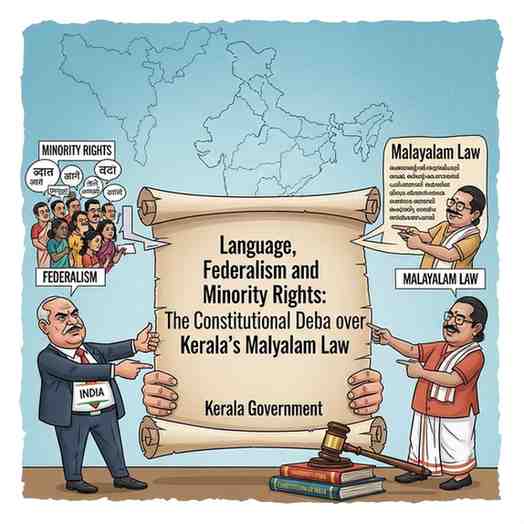
Language, Federalism and Minority Rights: The Constitutional Debate over Kerala’s Malayalam Law

The Malayalam Language Bill and the Federal Test of Linguistic Balance

Language policy in India has rarely been a neutral administrative choice. It lies at the intersection of identity, education, federal autonomy and minority rights. The Malayalam Language Bill, 2025, passed by the Kerala Legislative Assembly, exemplifies this tension. While the Kerala government projects the law as a legitimate assertion of linguistic self-governance, objections from Karnataka have transformed it into an inter-State dispute, reopening older debates about how far a State can go in promoting its language without marginalising linguistic minorities.

Month: 

Category: 

Startup India at Ten: From Policy Experiment to Pillar of India’s Developmental State

National Startup Day 2026 marks a decade of the Startup India Initiative—a policy intervention that has quietly altered India’s economic structure and innovation culture. Launched in 2016 as an attempt to energise entrepreneurship, Startup India has evolved into one of the world’s largest and most diverse startup ecosystems. More importantly, it has moved beyond the narrow lens of disruption and valuation to become a strategic instrument for jobs, inclusion, productivity and long-term national development, aligning closely with India’s vision of Viksit Bharat 2047.

Month: 

Category: