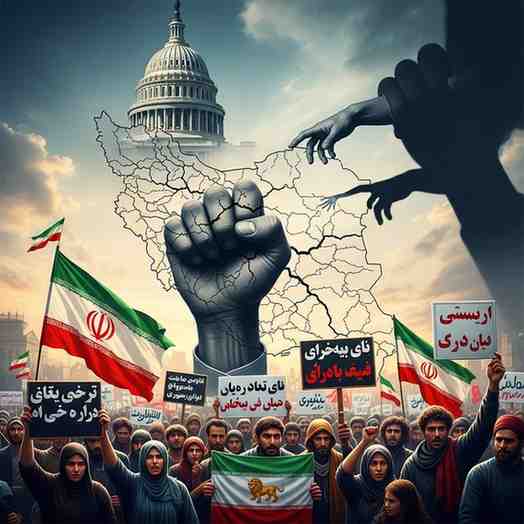
As protests rage across Iran and US President Donald Trump declares that “help is on its way”, the possibility of escalation is no longer hypothetical. With over 2,500 reportedly killed since demonstrations erupted on December 28 and a sweeping communications blackout in place, the Iranian regime is facing its gravest internal challenge in years. Washington’s response — whether diplomatic, military, or something in between — will not only shape Iran ’s trajectory but also test India’s diplomatic balancing act in an increasingly volatile West Asia.
Why the protests have reached a critical point
The current wave of unrest has escalated rapidly in both scale and intensity. Strikes and demonstrations have spread across cities, with security forces responding through lethal force, internet shutdowns, and electricity cuts. Persian-language media outside Iran report large casualties, figures that cannot be independently verified but point to a severe crackdown.
Trump’s public warning — coupled with reports of unprecedented repression since last Thursday — has raised expectations among protesters and sharpened anxieties within the regime. The Indian embassy’s advisory on January 14 asking Indians to leave Iran underscores how seriously regional actors are taking the risk of escalation.
Diplomacy remains Washington’s first lever
Despite the rhetoric, diplomacy remains the US administration’s stated first option. Iran has a long track record of negotiating its way out of pressure, most notably when sanctions under the Barack Obama administration eventually led to talks culminating in the Joint Comprehensive Plan of Action .
Iran’s political system may be factionalised — with moderates favouring engagement and hardliners pushing confrontation — but all sides converge on one goal: regime survival under the authority of Supreme Leader Ayatollah Ali Khamenei. This makes tactical negotiations a familiar survival strategy.
Reflecting this, the White House has indicated openness to exploring “private” Iranian messages. Yet, officials have also stressed that all options remain on the table, signalling that diplomacy is backed by coercive leverage.
Calibrated military strikes: the middle path?
If diplomacy stalls, the US could opt for limited, calibrated strikes, potentially coordinated with Israel. Likely targets would include Revolutionary Guard infrastructure, command-and-control centres, and weapons depots used by Iranian-backed militias.
A higher-risk threshold would be direct attacks on senior leadership — an option demonstrated during Trump’s first term with the killing of Qassem Soleimani. Trump has previously suggested that even Iran’s supreme leader could be targeted, though such an action would carry enormous escalation risks.
Iran’s conventional vulnerabilities have already been exposed. Last year’s brief but intense conflict saw US and Israeli strikes degrade Iran’s air defences, enabling deep-penetration attacks on fortified nuclear facilities.
The growing US military posture in the region
Washington’s military signalling has intensified. According to reports, United States Central Command has deployed six naval vessels across the Arabian Gulf and the Red Sea , including Arleigh Burke-class destroyers and littoral combat ships equipped for multi-domain warfare.
This posture leverages US-friendly regional bases in Saudi Arabia , the UAE, and beyond. Yet it also highlights a constraint: any US action would largely operate from outside Iranian territory, limiting the likelihood of decisive regime change.
As one senior diplomat put it, “It is very difficult to do a regime change from 30,000 feet above.”
The high-risk ground option — and why it’s unlikely
A ground intervention remains the most decisive but also the most dangerous option. Comparisons with recent US operations elsewhere, including the capture of Venezuela’s leader, overlook Iran’s vastly stronger security apparatus and the Revolutionary Guards’ tight command structure.
A ground confrontation would almost certainly lead to significant casualties and could spiral into a prolonged war — a scenario deeply unpopular with Trump’s MAGA base, still scarred by Iraq and Afghanistan. Politically and militarily, this remains the least likely path.
India’s dilemma amid US–Iran tensions
For India, escalation would have immediate and complex consequences. Diplomatically, New Delhi would find it difficult to openly support US military action inside Iran, consistent with its long-standing preference for dialogue and stability.
Economically, while India has largely phased out Iranian oil imports due to earlier US sanctions, the stakes remain high. Nearly 60% of India’s energy imports come from West Asia, and any regional turmoil — especially Iranian retaliation against US bases in Saudi Arabia , the UAE, or Qatar — would threaten energy security and fuel inflation.
Human stakes are equally large. With 8–9 million Indians living and working across West Asia, instability puts lives, remittances, and evacuation preparedness under strain.
A region on the brink, choices narrowing
As protests continue and US pressure mounts, the window for a peaceful de-escalation is narrowing. Iran’s leadership appears determined to crush dissent, while Washington is weighing how far it is willing to go to deter violence.
For India, the priority will be safeguarding its citizens, energy flows, and diplomatic autonomy — all while navigating a crisis where the actions of others could rapidly reshape the regional order. In West Asia, once again, events may move faster than diplomacy can catch up.
Month: Current Affairs - Jan 16, 2026
Category: