How Cold Reaches Its Extreme in Physics: Exploring the Ultracold Quantum World
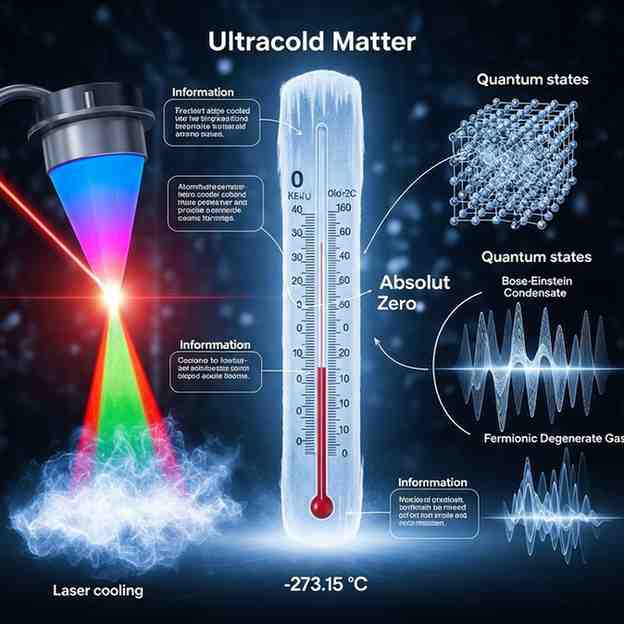
In everyday use, cold simply means low temperature. In physics, however, cold has a sharply defined and extraordinary limit. The coldest temperature possible is absolute zero , measured as –273.15°C , where atomic motion is reduced to its minimum allowed by nature. Modern experiments now routinely approach this boundary, cooling matter to billionths of a degree above absolute zero and revealing a realm governed entirely by quantum mechanics.
What “Cold” Means in Physics
Temperature is a measure of how fast atoms and molecules move. Cooling a substance slows this motion. As temperatures approach absolute zero, atoms lose their classical behaviour and begin to act like quantum waves rather than tiny solid particles.
This domain, known as ultracold matter , allows scientists to directly observe quantum phenomena that are usually hidden at ordinary temperatures. Effects such as wave interference, tunnelling, and quantum coherence become visible on laboratory scales.
Laser Cooling: Slowing Atoms with Light
Atoms cannot be cooled by conventional means like refrigeration. Instead, physicists use laser cooling , a technique that exploits the momentum carried by light.
When lasers are tuned precisely, photons strike atoms in such a way that they oppose atomic motion , effectively slowing the atoms down. Multiple laser beams arranged from different directions act like a viscous fluid of light, bringing atoms almost to rest.
This revolutionary method led to the 1997 Nobel Prize in Physics . By the late 1990s, scientists had achieved temperatures as low as one millionth of a degree above absolute zero , laying the foundation for deeper quantum experiments.
Bose–Einstein Condensate: Matter Becomes One
At even lower temperatures, a dramatic transformation occurs. Atoms merge into a single quantum state called a Bose–Einstein Condensate (BEC) .
First predicted in the 1920s and realised experimentally in 1995, a BEC behaves like a single giant quantum object . In this state, atoms can flow without friction, form standing wave patterns, and interfere with themselves—effects normally seen only in subatomic particles.
BECs allow researchers to study quantum mechanics on a scale visible under microscopes, bridging theory and experiment in a unique way.
Exam-Focused Key Points
-
Absolute zero is −273.15°C, the theoretical minimum temperature.
-
Laser cooling slows atoms using the momentum of photons.
-
Bose–Einstein Condensate is a distinct state of matter at ultralow temperatures.
-
At ultracold temperatures, quantum mechanics dominates over classical physics.
Applications and India’s Role in Ultracold Physics
Ultracold atom research underpins some of today’s most precise technologies. Atomic clocks , which rely on ultracold atoms, form the backbone of GPS navigation, telecommunications, and global timekeeping. These systems are also used in ultra-sensitive detectors for gravity, magnetic fields, and inertial navigation.
India has built strong expertise in this frontier area through institutions such as Tata Institute of
Month: Current Affairs - January 15, 2026
Category: Physics, Quantum Technology