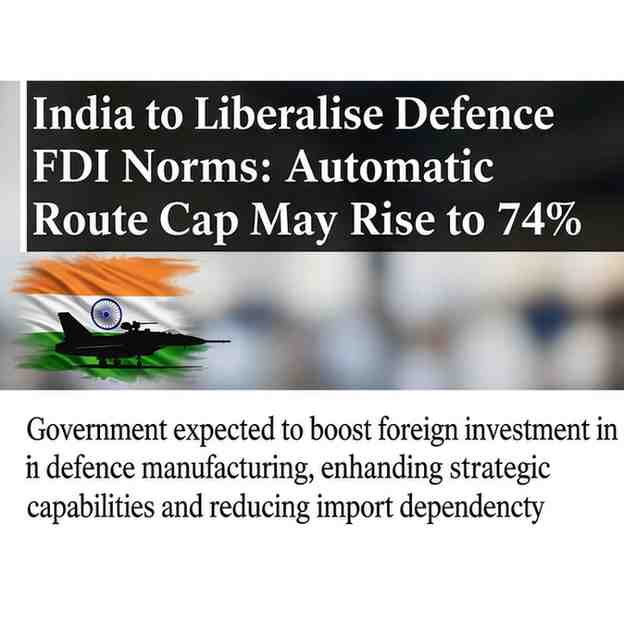
India Plans Major Liberalisation of Defence FDI Norms to Attract Global Manufacturers
India is set to undertake a significant liberalisation of foreign direct investment (FDI) norms in the defence sector, aiming to attract global manufacturers, strengthen domestic production, and reduce reliance on imports. According to a report by Reuters , the proposed reforms form part of a broader strategy to position India as a competitive global defence manufacturing hub.
The move aligns with India’s long-term objective of enhancing self-reliance in defence production while deepening strategic partnerships with technologically advanced countries.
Automatic Route FDI Cap Likely to Be Raised
Under the proposed changes, the FDI cap under the automatic route for defence companies holding existing industrial licences is expected to be raised from 49 per cent to 74 per cent . The automatic route permits foreign investment without prior approval from the government.
Currently, up to 74 per cent FDI is allowed automatically only for companies seeking new defence licences , while existing licence holders face tighter restrictions. The proposed reform would bring parity between new and existing players, improving investment predictability.
Review of the ‘Modern Technology’
The government is also reconsidering the clause that allows FDI beyond 74 per cent only if it leads to access to “modern technology.” This provision has been widely criticised by industry stakeholders for its lack of clarity and subjective interpretation, often discouraging large-scale foreign investments.
Officials are examining ways to simplify or redefine this requirement to remove uncertainty and accelerate decision-making.
Enabling Majority Foreign Ownership in Joint Ventures
A key objective of the proposed liberalisation is to permit majority foreign ownership in Indian defence joint ventures, particularly with companies from strategic partner countries. Government sources indicated that the reforms could be implemented within the next few months , significantly improving India’s attractiveness for long-term defence investments.
This shift is expected to encourage global manufacturers to relocate production lines, integrate Indian suppliers into global value chains, and transfer advanced manufacturing capabilities.
Export Norms and Foreign Inflows Under Review
Another reform under consideration is the removal of the requirement for fully export-oriented defence manufacturers to establish domestic maintenance, repair, and overhaul (MRO) facilities. Former defence ministry official Amit Cowshish has argued that permitting outsourcing of such services would substantially lower entry barriers for foreign firms.
Despite collaborations involving global defence majors such as Airbus , Lockheed Martin , and Rafael Advanced Defense Systems , foreign equity inflows into India’s defence sector have remained modest.
Government data shows cumulative FDI of $26.5 million over 25 years until September 2025 , compared to total foreign inflows of $765 billion during the same period.
Strategic Push for Defence Manufacturing Hub
The proposed FDI reforms complement India’s push to increase defence spending, expand domestic production capacity, and achieve a defence export target of $5.5 billion by 2029 . Together, these measures are expected to strengthen India’s position as a reliable global supplier of defence equipment.
Month: Current Affairs - January 17, 2026
Category: FDI Policy | Make in India