Overview
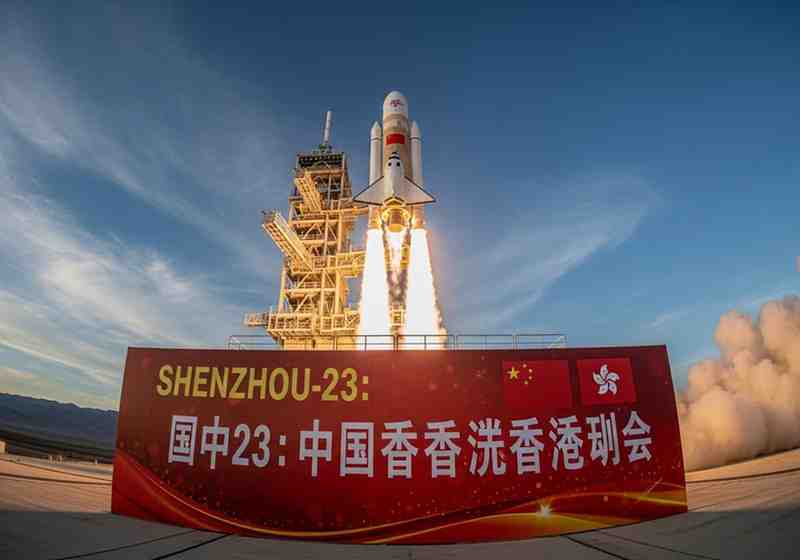
China launched Shenzhou-23 on 24 May 2026. The crew includes a former Hong Kong police officer, who is the first astronaut from Hong Kong. The mission docked with the Tiangong space station in just 3.5 hours. One astronaut will stay for one full year.
A New Chapter for China’s Space Dream
China is moving very fast in space exploration. On 24 May 2026, China launched the Shenzhou-23 mission. A Long March 2-F rocket carried three astronauts into the sky from the Jiuquan launch centre in north-western China. Just about 3.5 hours later, on 25 May 2026, the spacecraft docked with the Tiangong space station. This was a very quick journey. The mission is special for many reasons. One astronaut is from Hong Kong. Another astronaut will stay in space for a full year. Let us learn all about this exciting mission.
The Shenzhou-23 Mission
Shenzhou is China’s crewed spacecraft series. It is used to send humans to space. The Long March 2-F rocket is a trusted launch vehicle for crewed missions. The launch happened on 24 May 2026. The docking happened early on 25 May 2026. The whole trip took only 3.5 hours. This is much faster than older missions. Fast docking means less time inside a small spacecraft and more time working on the space station. The Tiangong space station is China’s home in space. It is modular, meaning different parts were joined together over time. Tiangong is designed for long-duration human spaceflight. Astronauts live and work there for months.
The Crew: Three Brave Astronauts
The Shenzhou-23 crew has three members. Each one has a different background.
Zhu Yangzhu is a space engineer. He knows how spacecraft and space stations work. He will take care of technical systems on Tiangong.
Zhang Zhiyuan is a former air force pilot. He has flown fighter jets. He brings flying experience and quick decision-making skills.
Lai Ka-ying is a former Hong Kong police officer. He is now an astronaut. He made history because he became the first astronaut from Hong Kong to undertake a spaceflight. This is a very proud moment for Hong Kong. It shows that people from all parts of China can join the space programme. Lai Ka-ying worked very hard to become an astronaut. His journey from police officer to space traveller is inspiring.
Tiangong Space Station: A Laboratory in the Sky
Tiangong is China’s modular space station. It is a key platform for long-duration human spaceflight. The station has living quarters, science labs, and docking ports. Astronauts can stay there for many months. The station is used to do experiments that cannot be done on Earth. For example, in microgravity, things float. Scientists can study how crystals grow, how fluids move, and how plants grow without gravity. Tiangong also helps China prepare for even bigger goals, like sending humans to the Moon.
One-Year Mission: Studying the Human Body in Space
One astronaut on Shenzhou-23 is scheduled to remain on Tiangong for one full year. That is a very long time. The human body changes in space. Muscles become weaker because they do not have to work against gravity. Bones lose density. Eyesight can change. The heart works differently. Blood flows to the head more. By studying a person for one year, scientists can learn how the body adapts.
Month: Current Affairs - May 25, 2026
Category: China’s Space Programme