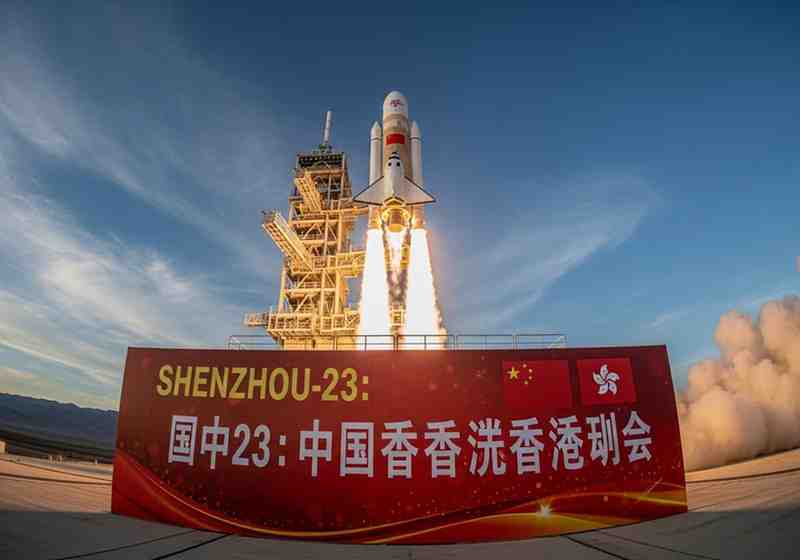
This knowledge is very important for future long missions. If China wants to send astronauts to the Moon or Mars, they must know how to keep them healthy. The one-year astronaut will do regular health checks, take blood samples, and do exercise routines. The results will help space agencies all over the world.
Experiments on Tiangong
The Shenzhou-23 mission includes many experiments. Here are some areas of research:
-
Life sciences – Studying plants, animals, and even bacteria in space.
-
Materials science – Seeing how metals, crystals, and other materials form without gravity.
-
Fluid physics – Understanding how liquids behave when they do not fall down.
-
Medicine – Testing new drugs and learning about human health in space.
These experiments can lead to new inventions on Earth. For example, better medicines or stronger materials.
China’s Lunar Programme: Aiming for the Moon by 2030
China has a big goal. It wants to land humans on the Moon by 2030. That is just four years away. China is already working on a new spacecraft called Mengzhou. Mengzhou is planned for an orbital test flight in 2026. This spacecraft is designed to replace the Shenzhou line for future lunar missions. Shenzhou is good for going to the space station, which is close to Earth. But going to the Moon needs a bigger, stronger spacecraft. Mengzhou will be that vehicle. China also plans the first phase of the International Lunar Research Station by 2035. This will be a base on the Moon where astronauts can live and work. Many countries may join this project.
International Cooperation: Welcoming Friends
China does not want to go to space alone. It wants to work with other countries. China plans to welcome its first foreign astronaut from Pakistan to the Tiangong space station by the end of 2026. This is a big step in international cooperation. Pakistan and China are good friends. Sending a Pakistani astronaut to Tiangong will strengthen their friendship. In the future, more countries may send their astronauts to China’s space station. The International Lunar Research Station is also planned as a manned scientific base. The first phase is targeted for 2035. This base could be like a small village on the Moon.
Comparison with NASA’s Artemis Programme
The United States also has a lunar programme. It is called NASA’s Artemis programme. Artemis wants to send the first woman and the next man to the Moon. It also plans to build a base on the Moon. Both China and the USA are racing to the Moon. But they also have chances to work together. Space exploration is not just about competition. It is about learning and growing as humans.
Conclusion: A Bright Future in Space
Shenzhou-23 is a proud moment for China. It shows that China can send astronauts to space quickly and safely. The first Hong Kong astronaut makes the mission even more special. The one-year stay will teach us how to keep humans healthy on long journeys. With plans to go to the Moon by 2030, China is becoming a top space power. We should watch the skies and cheer for all the brave astronauts who leave Earth to explore the
Month: Current Affairs - May 25, 2026
Category: China’s Space Programme