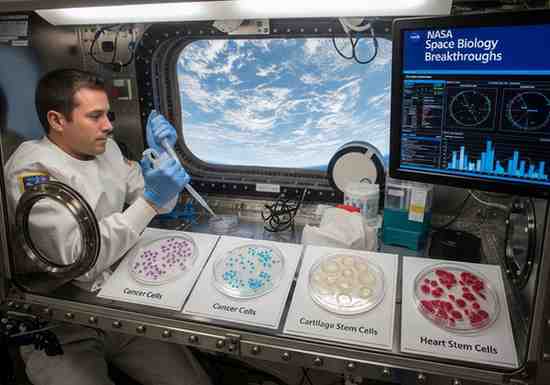
Cancer drug by Merck; FDA approved injectable form in September 2025
Microgravity benefits: Tumour spheroids and organoids grow in 3D for better drug testing
Key past results: Tumour spheroids tripled in size in 10 days (Dec 2024); heart organoids created in space (June 2025); tumour-on-a-chip for chemotherapy studies
FAQ
Q1: What biomedical experiments did NASA conduct on the ISS in May 2026?
Ans: They studied cancer therapeutics, cartilage tissue growth, heart stem cells, and DNA-inspired nanomaterials.
Q2: Which laboratory module did the astronauts use for these experiments?
Ans: They used the Japanese Kibo laboratory module and its Life Science Glovebox.
Q3: Why is microgravity useful for cancer research?
Ans: Microgravity helps cancer cells form three-dimensional tumour spheroids and organoids, which are better for testing drugs.
Q4: Who is the NASA astronaut that studied cartilage tissue growth in space?
Ans: NASA Flight Engineer Jessica Meir studied cartilage tissue growth in space.
Q5: What is pembrolizumab and when was its injectable form approved?
Ans: Pembrolizumab is a cancer medicine by Merck. Its injectable formulation received US FDA approval in September 2025.
Month: Current Affairs - May 22, 2026
Category: Science & Technology -Space and Health