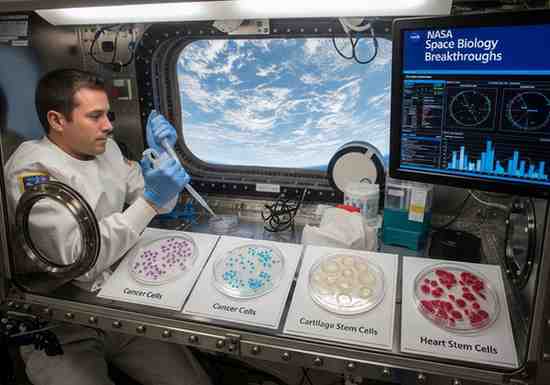
Kibo means “hope” in Japanese. It is the Japanese Experiment Module on the ISS. Kibo is a large laboratory that has special facilities for life science experiments. One of its key tools is the Life Science Glovebox. This is a sealed box with built-in gloves. Astronauts put their hands inside to handle cells, bacteria, and other biological samples safely. Kibo also has storage for samples and powerful microscopes.
What Is Microgravity?
Microgravity is the near-weightless condition in space. On the ISS, things float because the station is in free fall around Earth. This condition is very useful for science. For example, cancer cells can form three-dimensional tumour models in microgravity. These include tumour spheroids (small round clumps of cells) and organoids (miniature organs). On Earth, gravity flattens cells. In space, they grow in a more natural 3D shape. This makes drug testing more accurate.
Other Important Space Cancer Research
NASA and the ISS National Laboratory have been doing cancer research for some time.
-
July 2024: The ISS National Laboratory and NASA selected five projects under the “Igniting Innovation” solicitation. One project at the University of California, San Diego, studied accelerated cancer development in microgravity. The team used patient-derived tumour organoids.
-
December 2024: At the Sanford Stem Cell Institute of UC San Diego, tumour spheroids tripled in size in just 10 days in microgravity. This rapid growth helps scientists test drugs faster.
-
June 2025: Cedars-Sinai cell biologists led by Arun Sharma used pluripotent stem cells to create heart organoids in space. They studied how cancer drugs affect the heart. Microgravity helped maintain the 3D structures.
-
Encapsulate also used a “tumour-on-a-chip” system. This tiny device mimics a real tumour. It helps study chemotherapy drugs in space-based cancer models.
A Key Cancer Medicine: Pembrolizumab
Pembrolizumab is a cancer medicine made by Merck. In September 2025, the United States Food and Drug Administration (FDA) approved an injectable form of this drug. It is used for many types of cancer. Space experiments may help improve such drugs further.
Exam-Focused Points
-
Event: Biomedical experiments on ISS during Expedition 74 (May 2026)
-
Astronauts involved: Chris Williams, Jessica Meir, Jack Hathaway (NASA), Sophie Adenot (ESA)
-
Experiments: Cancer therapeutics, cartilage growth, heart stem cells, DNA-inspired nanomaterials
-
Facility used: Japanese Kibo laboratory module and Life Science Glovebox
-
Cancer focus: Pancreatic cancer therapies, drug behaviour in microgravity
-
Cartilage: Connective tissue in joints, nose, ear, rib cage; 3D formation studied in space
-
Heart stem cells: Processed on 23 April 2026 for heart-condition treatments
-
DNA nanomaterials: For immunotherapies and chemotherapies
-
Pembrolizumab:
Month: Current Affairs - May 22, 2026
Category: Science & Technology -Space and Health