Overview
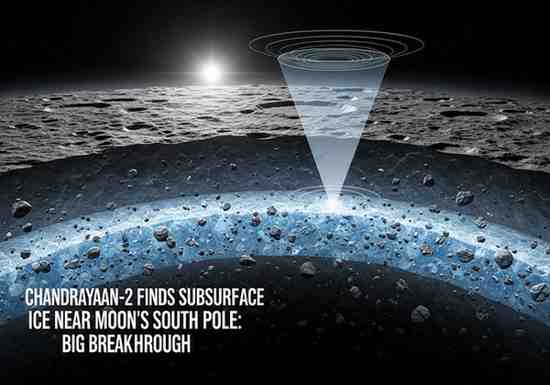
ISRO announced on 27-28 May 2026 that Chandrayaan-2 found strong evidence of subsurface ice in a 1.1-km crater near the Moon's south pole. The ice is inside a doubly shadowed crater in Faustini crater. This discovery supports future human missions.
A Major Announcement by ISRO
On 27 and 28 May 2026, the Indian Space Research Organisation (ISRO) made a big announcement. Scientists found strong evidence of possible subsurface ice near the Moon's south pole. They used data from Chandrayaan-2, India's second Moon mission. The orbiter has been circling the Moon since 2019. The discovery came from the Ahmedabad-based Physical Research Laboratory (PRL). This finding is very important for future space exploration. It tells us that the Moon may have water ice below its surface.
What is Chandrayaan-2's DFSAR?
Chandrayaan-2 carries a special instrument. It is called the Dual Frequency Synthetic Aperture Radar, or DFSAR for short. This is a microwave imaging instrument. It works in two frequencies: L-band and S-band. DFSAR is the first fully polarimetric synthetic aperture radar to study the Moon. That means it can send radar waves and measure how they bounce back. It can also see below the Moon's surface. This helps scientists find things hidden under the lunar soil. The DFSAR is very powerful. It can image the surface from 2 metres to 75 metres in resolution.
Doubly Shadowed Craters: The Coldest Places on the Moon
The scientists focused on something called "doubly shadowed craters". These are small craters that sit inside larger permanently shadowed regions (PSRs). PSRs are areas near the lunar south pole that never get direct sunlight. They are always in darkness. Doubly shadowed craters are even darker. They are shielded from both sunlight and thermal radiation. As a result, they are extremely cold. Temperatures there drop to around 25 Kelvin. That is minus 248 degrees Celsius. These are among the coldest places in the entire solar system. Such extreme cold is perfect for preserving water ice for billions of years.
Evidence from Four Craters, Strongest in Faustini
The PRL scientists studied nine doubly shadowed craters. These craters lie inside three larger craters: Faustini, Haworth, and Shoemaker. Using the DFSAR data, they found radar signatures that suggest subsurface ice beneath four of these nine craters. Among the four, one crater showed the strongest evidence. This crater is about 1.1 kilometres wide . It sits inside the larger Faustini crater near the Moon's south pole. The evidence is very convincing.
CPR and DOP: How Radar Sees Ice
The scientists used two radar parameters to find the ice. These are the Circular Polarization Ratio (CPR) and the Degree of Polarization (DOP). Here is how they work.
Circular Polarization Ratio (CPR): When radar waves hit ice-rich material, they scatter in a special way. This scattering can produce CPR values greater than 1 . But rough rocky terrain can also produce high CPR values. So CPR alone is not enough.
Degree of Polarization (DOP): DOP measures how much of the reflected radar signal keeps its original polarisation state. For subsurface ice, DOP values are lower than 0.13 . When scientists combine CPR greater than 1 and DOP lower than 0.13, it strongly suggests volumetric scattering. That is the kind of scattering you get from ice mixed with soil. This method
Month: Current Affairs - May 28, 2026
Category: ISRO-Chandrayaan2