helps separate real ice signals from signals produced by rough rocks.
Lobate-Rim Morphology: A Flow-Like Shape
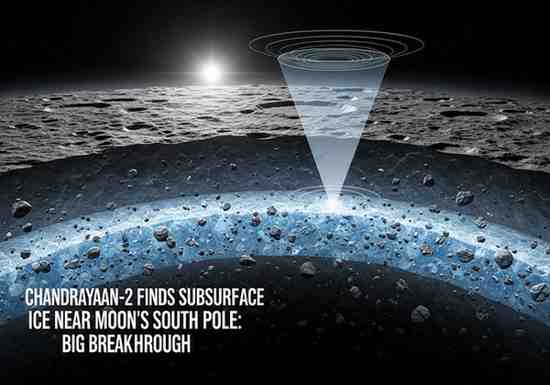
The 1.1-km crater inside Faustini has another special feature. It shows a "lobate-rim morphology". This means the crater's rim has a flow-like or lobed shape. Imagine a crater whose edges look like they flowed outward. Scientists believe this shape forms when an impact hits an ice-rich layer below the surface. The impact melts or moves the ice. The material then flows and freezes again, creating the lobed rim. This morphology provides extra evidence that subsurface ice exists at that location. It supports what the radar data already suggested.
Why 25 Kelvin Matters
The temperature inside doubly shadowed craters is about 25 Kelvin. That is extremely cold. Water ice can remain stable at such temperatures for billions of years. The ice does not melt or evaporate. This means any water ice that got trapped there long ago is still there today. The Moon has no atmosphere. Temperatures on the sunny side can reach over 100 degrees Celsius. But in these deep, dark craters, it never gets warm. So the ice is preserved.
Why This Discovery Matters for Future Moon Missions
Water ice on the Moon is extremely valuable. It can be used for many purposes. Astronauts can drink the water. They can breathe oxygen extracted from the water. They can also split water into hydrogen and oxygen to make rocket fuel. If we have water on the Moon, we do not have to carry it from Earth. That saves a lot of money and weight. This discovery helps future missions. NASA's Artemis programme and ISRO's future lunar expeditions can use this information. They can plan to land near these ice-bearing regions. They can send rovers to drill and extract the ice. This discovery brings us one step closer to a permanent human presence on the Moon.
Chandrayaan-2: Still Working After All These Years
Chandrayaan-2 was launched in July 2019. The lander named Vikram crashed during its landing attempt. But the orbiter survived. It is still healthy and all its instruments are working. The orbiter has been sending valuable data for nearly seven years. It has helped create high-resolution maps of the Moon's poles. This new discovery shows that old data can still yield new results. Chandrayaan-2 continues to be a success for ISRO.
Exam-Focused Points
-
Date of announcement: 27-28 May 2026.
-
Mission: Chandrayaan-2 orbiter.
-
Instrument: Dual Frequency Synthetic Aperture Radar (DFSAR) – first fully polarimetric SAR on the Moon.
-
DFSAR frequencies: L-band and S-band .
-
Target area: Doubly shadowed craters inside permanently shadowed regions near the Moon's south pole .
-
Total craters studied: 9 inside Faustini, Haworth, and Shoemaker.
-
Craters showing subsurface ice evidence: 4.
-
Strongest evidence: 1.1-km-wide crater inside Faustini crater .
-
Radar
Month: Current Affairs - May 28, 2026
Category: ISRO-Chandrayaan2