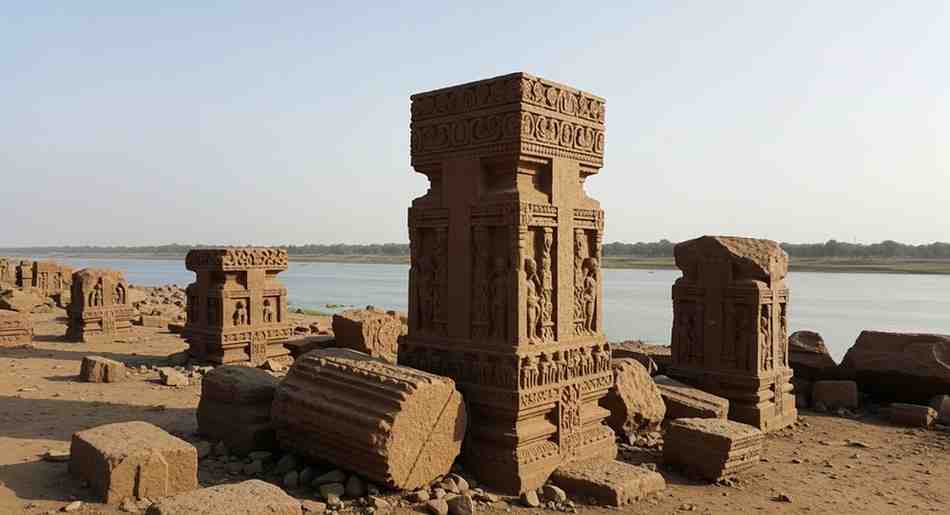
Hemadpanti-Style Remains Point to Yadava-Era Temple at Hinganghat
Fragments of a 12th-century Mandir-style stone pillar have been identified near the Vena River in Hinganghat town, Wardha district, Maharashtra. Located about 70 km from Nagpur, the discovery is considered significant evidence of the region’s medieval cultural prominence.
Discovery and Architectural Assessment
The carved fragments were noticed during a survey of ancient temple sites along the riverbank. Detailed examination by local researchers confirmed stylistic elements linked to the Seuna Yadava dynasty of the 12th–13th centuries.
Preliminary analysis suggests the pillar may have formed part of a sabhamandap (assembly hall) or stood before the garbhagriha (sanctum). Another recovered piece appears to be the base of a principal structural column, indicating that a sizeable temple complex once existed at the site.
Hemadpanti Craftsmanship
The fragments are carved from black basalt, a hard volcanic rock common in Deccan temple architecture. A prominent lotus motif highlights refined sculptural skill despite the material’s density. The design elements align with the Hemadpanti style—an architectural tradition associated with Yadava-era constructions.
Hemadpanti temples are distinguished by precisely cut stone blocks assembled without lime mortar, relying instead on interlocking techniques. This style is widely seen across Maharashtra and Vidarbha, reflecting regional architectural innovation during medieval rule.
Historical Significance of Hinganghat
Historical records indicate that Vidarbha prospered culturally and economically under Yadava governance. Settlements and temple sites along the Vena River suggest Hinganghat may have been an active religious centre during that period.
Important Facts for Exams
-
Seuna (Yadava) dynasty ruled parts of the Deccan in the 12th–13th centuries.
-
Hemadpanti architecture uses mortarless interlocking stone construction.
-
Black basalt is commonly used in Deccan temple structures.
-
Garbhagriha refers to the innermost sanctum of a Hindu temple.
Researchers have urged authorities and the Archaeological Survey of India to conduct systematic excavation and protect the exposed remains. Further scientific study may reveal additional structures, enhancing understanding of the region’s medieval heritage.
Month: Current Affairs - Mar 03, 2026
Category: Art & Culture | Medieval India