Eclipse Season Explained: The Science Behind Solar and Lunar Eclipses
Solar and lunar eclipses often seem sudden, appearing only after weeks of ordinary new and full moons. This perception, however, masks the underlying celestial mechanics. Eclipses are not random phenomena but components of a precisely predictable orbital cycle governed by the geometry of the Sun, Earth, and Moon.
What Is an Eclipse Season?
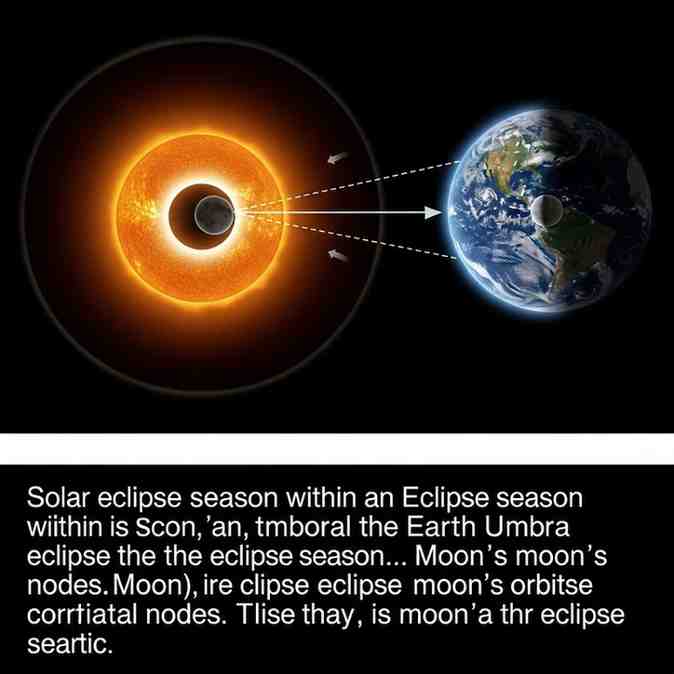
An eclipse season is a recurring interval during which the alignment of the Earth–Moon system allows eclipses to occur. These windows arise because the Moon’s orbit is tilted by about 5° relative to Earth’s orbital plane (the ecliptic). Most months, this inclination prevents perfect alignment, causing the Moon to pass slightly above or below the Sun from Earth’s perspective.
Approximately every six months, the Sun appears close to one of the Moon’s orbital nodes — the points where the Moon’s path crosses the ecliptic. During this period, syzygy (new or full moon alignment) can produce eclipses.
Why Do Eclipses Come in Pairs?
Each eclipse season lasts roughly 34–37 days, long enough for both a new moon and a full moon to occur. Since:
-
Solar eclipses happen at new moon
-
Lunar eclipses happen at full moon
… two eclipses typically occur about two weeks apart.
For early 2026, the first eclipse season spans February 17 to March 3 , yielding:
-
Annular Solar Eclipse (New Moon)
-
Total Lunar Eclipse (Full Moon)
Predictability of Eclipse Cycles
Eclipse timing follows well-known cycles, particularly the Saros Cycle (~18 years 11 days), which links eclipses with similar geometries.
Exam-Focused Points
-
Eclipse seasons occur twice yearly on average
-
Caused by alignment near orbital nodes
-
Solar eclipse → New Moon
-
Lunar eclipse → Full Moon
-
Typical separation: ~14 days
-
Saros Cycle: 18 years 11 days
Month: Current Affairs - February 15, 2026
Category: Astronomy | Space Science