Overview
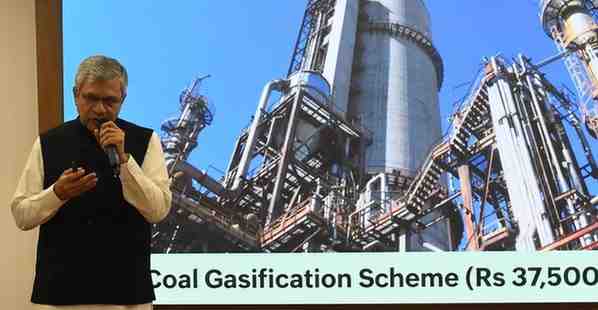
The Union Cabinet led by Narendra Modi has approved a ₹37,500 crore coal gasification scheme. The project aims to reduce India’s dependence on imported fuel, chemicals, and fertilizers. The government plans to use domestic coal and lignite reserves to produce valuable industrial products such as methanol, ammonia, and synthetic natural gas. The scheme is also part of India’s long-term energy security strategy.
Cabinet Approves Major Coal Gasification Scheme
The Union Cabinet approved a major financial support scheme for coal and lignite gasification projects across India.
Key Project Details
-
Total scheme value: ₹37,500 crore
-
Target: Gasification of 75 million tonnes of coal and lignite
-
National target: 100 million tonnes of coal gasification by 2030
The project supports India’s effort to strengthen domestic energy production.
What is Coal Gasification?
C+H2O→CO+H2C + H_2O \rightarrow CO + H_2C+H2O→CO+H2
Coal gasification is a process that converts coal or lignite into synthetic gas, also called syngas.
Instead of directly burning coal, the process changes it into a useful gas mixture.
Main Components of Syngas
-
Hydrogen
-
Carbon monoxide
-
Small amounts of methane
-
Carbon dioxide
Syngas can be used to produce fuel, fertilizers, and industrial chemicals.
Products to Be Made Under the Scheme
The government wants industries to produce several important products through coal gasification.
Major Products
These products are currently imported in large quantities.
Why is the Scheme Important?
India depends heavily on imports for many industrial and energy products.
India’s Import Dependence
-
More than 50% LNG imports
-
Nearly 100% ammonia imports
-
Around 80–90% methanol imports
-
Around 20% urea imports
Month: Current Affairs - May 14, 2026
Category: Coal Gasification Scheme