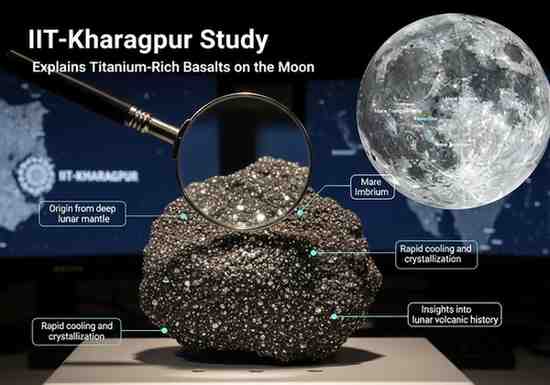
New Research Solves Mystery of High Titanium in Lunar Rocks
A new study by IIT Kharagpur and Physical Research Laboratory has explained the origin of titanium-rich basalts on the Moon. Published in Geochimica et Cosmochimica Acta , the research resolves a long-standing question in planetary geology.
Unusual Composition of Lunar Basalts
Lunar volcanic rocks show unusually high concentrations of titanium dioxide (TiO₂), reaching up to 18%, compared to less than 2% in most Earth basalts. These rocks formed from ancient lava flows billions of years ago, indicating unique geological processes in the Moon’s interior.
Experimental Approach and Findings
Researchers recreated lunar interior conditions through high-pressure and high-temperature experiments, simulating depths of nearly 700 km. The study proposes a two-stage formation mechanism involving partial melting, chemical interaction, and mixing between deep mantle material and titanium-rich layers. This model explains both the titanium and magnesium composition observed in lunar samples.
Role of Ilmenite-Bearing Layer
A key factor identified is the presence of an ilmenite-bearing cumulate (IBC) layer formed during the Moon’s early cooling phase. This dense layer sank into the mantle, partially melted, and generated titanium-rich magma. Over time, this magma mixed with rising molten material, eventually reaching the lunar surface as lava flows.
Implications for Future Lunar Missions
These findings are significant for upcoming missions such as Chandrayaan 4. Understanding lunar mineral composition can help identify suitable landing sites and improve sample collection strategies. The study also reflects India’s growing expertise in planetary science and experimental geophysics.
Exam-Focused Points
-
TiO₂ in lunar basalts: up to 18%
-
Key mineral: Ilmenite (titanium-bearing)
-
Mechanism: Two-stage melting and mixing process
-
Method: High-pressure, high-temperature experiments
-
Institutions: IIT Kharagpur & PRL Ahmedabad
-
Application: Supports future lunar missions (Chandrayaan-4)
Month: Current Affairs - March 25, 2026
Category: Space, Geology