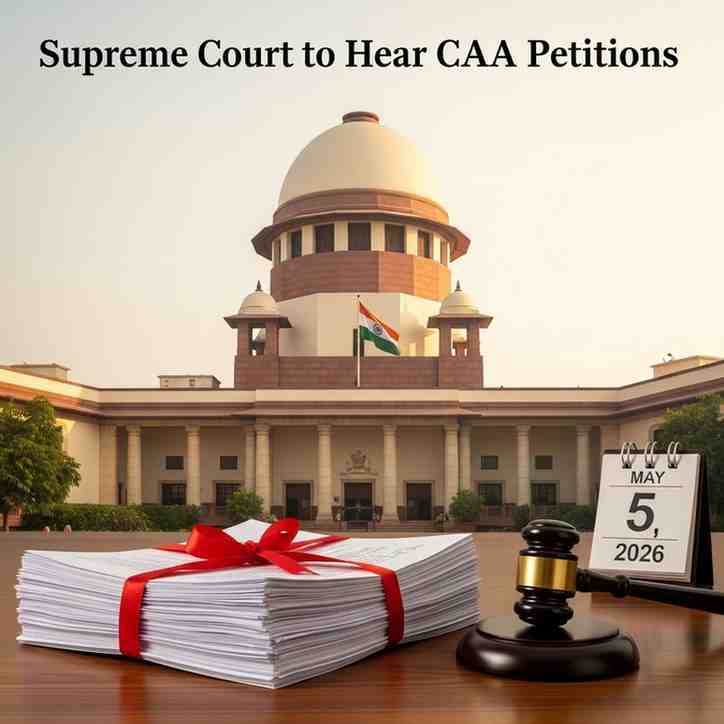
Constitutional Challenge to Citizenship Amendment Act Returns to Supreme Court
The Supreme Court of India is set to begin hearings on petitions contesting the Citizenship Amendment Act (CAA), 2019, from May 5, 2026. A three-judge bench comprising Chief Justice of India Surya Kant, Justice Joymalya Bagchi and Justice Vipul Pancholi scheduled the proceedings while issuing procedural directions. The petitions challenge the constitutional validity of the legislation enacted by Parliament in December 2019. The matter was last taken up in March 2024 and includes pleas filed from multiple states, with specific concerns raised by petitioners from Assam and Tripura.
Provisions of the Citizenship Amendment Act
The Citizenship Amendment Act, passed on December 11, 2019, modifies the Citizenship Act, 1955. It provides a fast-track route to Indian citizenship for individuals belonging to Hindu, Sikh, Buddhist, Jain, Parsi and Christian communities from Pakistan, Bangladesh and Afghanistan. Applicants must have entered India on or before December 31, 2014, and satisfy a reduced residency requirement of five years. The Act does not automatically grant citizenship but allows eligible individuals to apply subject to documentary verification and compliance with notified rules.
Issues Raised Before the Court
During preliminary submissions, Senior Advocate Indira Jaising argued that petitions linked to Assam and other North-Eastern states be heard separately, citing complexities involving Section 6A of the Citizenship Act and the Inner Line Permit framework. The Solicitor General supported categorising Assam- and Tripura-specific petitions distinctly. The bench indicated that matters concerning the rest of India would be heard first, followed by region-specific challenges. Hearings are scheduled for May 5 and 6, with respondents’ arguments to follow.
Constitutional and Regional Concerns
Petitioners have questioned whether the Act’s exclusion of Muslims violates Article 14, which guarantees equality before the law. In Assam, challengers argue that the Act undermines the Assam Accord of 1985 by revising migration-related cut-off considerations.
Important Facts for Exams
-
The Citizenship Amendment Act was enacted in December 2019.
-
It amends the Citizenship Act, 1955.
-
Section 6A of the Citizenship Act applies specifically to Assam.
-
The Assam Accord was signed in 1985.
Centre’s Position and Broader Implications
The Union Government maintains that the Act protects persecuted minorities without affecting existing citizens’ rights. The hearings are expected to shape constitutional interpretation, federal debates and migration policy discourse.
Month: Current Affairs - February 19, 2026
Category: Polity & Constitution | Judiciary