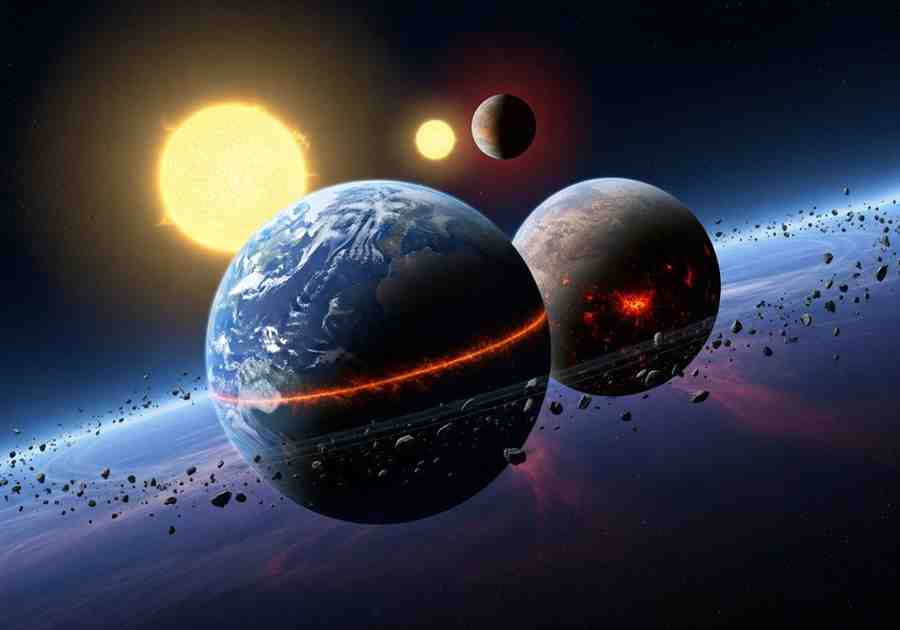
One of a Kind Planetary Discovery.
Astronomers have discovered a strange planetary system, which is approximately 120 light-years away, which gives new information about the planetary systems evolution. Its unusual arrangement and the existence of two earth-like planets make the system stand out as scientists have to reconsider the well-known theories of planetary formation.
Super-Earths in a Twin.
Two rocky planets (called super-Earths) can be found in the system, and are just a little bigger than Earth but smaller than Neptune. These planets can either be solid or have stratified interiors. Having two planets in the same system is rather a rarity and offers a possibility to compare the evolution of similar planets under similar conditions of the stellar environment.
An Uncommon Planetary Formation.
The layout of this system is interesting, especially because it is unexpected. Rocky planets are found nearer to the star in most planetary systems, and the gas giants are found farther away, as in our Solar System. Nevertheless, this system demonstrates the existence of a rocky planet which exists after the gas giants. This inversion plays with classical models and proposes a more complicated formation and migration history.
Planet Formation Theories to Rethink
The finding has prompted researchers to consider other possible explanations, including inside-out formation, or dramatic planetary movement through time. It suggests that planetary systems do not necessarily adhere to one universal system, but rather develop in a different way depending on several factors such as the composition of the protoplanetary disc, gravitational interactions, and stellar activity.
Exam-Focused Key Points
- Exoplanets are planets that are orbiting non Solar System stars.
- Super-Earths are bigger than earth, and still smaller than Neptune.
- Planets are created out of protoplanetary gas and dust disks.
- Standard model: rocky planets close to star, gas giants more distant.
- This system presents an in-inverted order, which defies the current theories.
Function of Space Telescopes
The observation made it possible through the use of sophisticated spacecrafts like NASA TESS and the European Space Agency CHEOPS telescope. These tools identify exoplanets by seeing periodic dips in the starlight as the planets pass around their host stars. These observations are critical to better inform our knowledge of planetary diversity and are able to refine solar system formation models.
Month: Current Affairs - April 08, 2026
Category: Space | Discoveries