Long-Lived Magnetic Activity Drives Intense Solar Flares
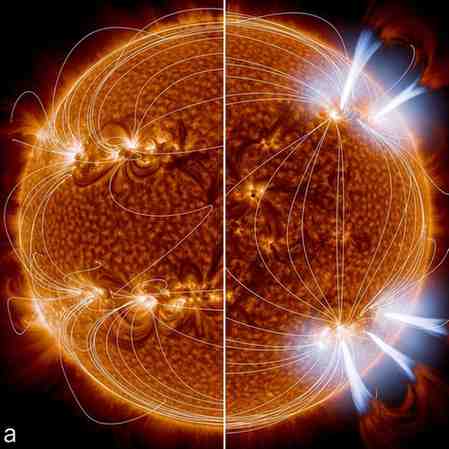
A recent study using data from Solar Dynamics Observatory has revealed why certain regions on the Sun generate more intense solar flares. The findings highlight that long-lasting magnetic activity plays a key role in producing powerful solar eruptions, advancing our understanding of space weather.
Magnetic Activity on the Sun’s Surface
The Sun’s surface contains regions of strong magnetic fields known as active regions. These areas can form rapidly but may persist for varying durations. The study focused on regions where magnetic activity remains stable for at least a month, indicating deeper and more organised magnetic structures.
Key Findings of the Study
Researchers found that long-lived active regions are significantly more productive in generating solar flares. Such regions are three to six times more likely to produce the most intense flares compared to short-lived ones. This demonstrates that stability and persistence of magnetic fields are crucial factors influencing solar flare intensity.
Role of Citizen Science and Data Analysis
The research incorporated data from the Solar Active Region Spotter initiative. Volunteers helped analyse solar images, enabling large-scale classification of active regions. This citizen science approach enhanced data processing and improved the accuracy of scientific results.
Implications for Space Weather Forecasting
The findings are important for predicting space weather events. Powerful solar flares can disrupt satellites, communication systems, navigation networks, and power grids on Earth. Identifying high-risk solar regions allows better forecasting and preparedness, while also deepening insights into solar magnetic processes.
Exam-Focused Points
-
Solar flares caused by magnetic activity on the Sun .
-
Data source: NASA Solar Dynamics Observatory .
-
Long-lived regions = 3–6 times more flare activity .
-
Citizen science project: Solar Active Region Spotter .
-
Impacts: satellites, communication, power grids .
-
Key factor: stability of magnetic fields .
Month: Current Affairs - March 23, 2026
Category: Science - Technology, Space